










Hello, this is your senior engineer from Eptahub. Today, let’s talk about a material that is both a designer’s dream and a potential engineering nightmare: Thermoplastic Rubber (TPR).
TPR is everywhere. It’s the soft-touch grip on your power tool, the flexible fin on a swim flipper, the chew toy for your dog, and the grommet sealing a wire pass-through. Its appeal is obvious: it feels like rubber, it can be processed with the speed and low cost of plastic, and it can be molded into complex, colorful shapes. This combination of properties makes it one of the most versatile tools in the materials playbook.
But this is where the danger lies. Its apparent simplicity and low cost can lure engineers and buyers into a false sense of security. I have been called in to analyze numerous product failures—sticky handles, warped seals, cracked components—where the root cause traces back to a single, vague line item on a drawing: “Material: TPR.”
Specifying “TPR” without understanding its inherent limitations is like ordering “red wine” at a five-star restaurant. You might get something acceptable, or you might get a cooking wine that ruins the entire meal. To source TPR effectively, you must first become an expert in its disadvantages. They are not edge cases; they are fundamental properties that define where and, more importantly, where ~ 아니다 to use this material.
First, A Critical Clarification: TPE vs. TPR
Before we discuss disadvantages, we must clear up the number one point of confusion in the elastomer world. What is the difference between TPE and TPR?
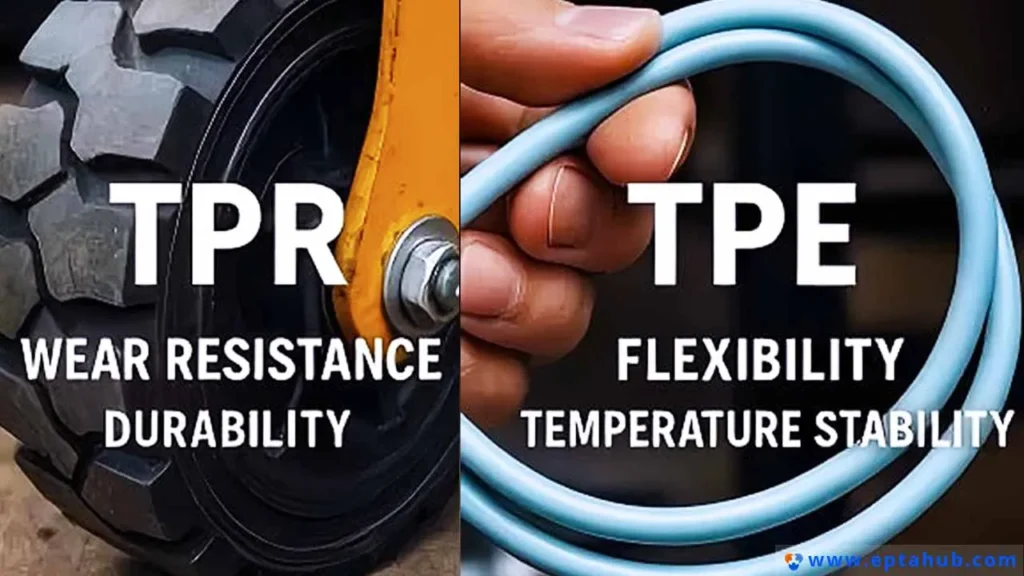
- TPE (Thermoplastic Elastomer) is the broad, overarching family name for all materials that exhibit both thermoplastic (melt-processable) and elastomeric (rubbery) properties. Think of “TPE” as the category “Fruit.”
- TPR (Thermoplastic Rubber) is a specific sub-class of TPE. Specifically, TPR historically refers to TPEs based on SBC (Styrenic Block Copolymer) chemistry, most commonly SBS (Styrene-Butadiene-Styrene). Think of “TPR” as the specific type “Apple.”
그래서, all TPRs are a type of TPE, but not all TPEs are TPRs. The TPE family also includes other chemistries like TPVs (vulcanized), TPUs (urethanes), and TPE-Es (copolyesters), each with different properties.
In today’s industry, the terms TPE and TPR are often used interchangeably, which adds to the confusion. However, for this guide, when we say “TPR,” we are focusing on the common, workhorse SBC-based compounds that are most susceptible to the disadvantages we will discuss.
The Science Behind TPR: Why It’s Both Great and Flawed
To understand TPR’s weaknesses, you need to understand its basic molecular structure. An SBS-based TPR is a block copolymer. Imagine a chain made of three segments:
[HARD PLASTIC] — [SOFT RUBBER] — [HARD PLASTIC]
- The Hard Blocks (Styrene): These ends are rigid, like plastic. At room temperature, the styrene ends of different chains clump together, forming strong physical “cross-links.” These are what give the material its strength and form.
- The Soft Block (Butadiene): The middle segment is a long, flexible, rubbery chain. This is what gives the material its elasticity and soft feel.
The magic of TPR is that these cross-links are physical, not chemical.
- When you heat it: The styrene “hard blocks” soften and melt, breaking the cross-links. The material flows like a liquid plastic, allowing it to be injection molded.
- When you cool it: The styrene blocks solidify again, re-forming the cross-links and locking the part back into its rubbery shape.
This is the opposite of a traditional thermoset rubber (like EPDM or Neoprene), which is “vulcanized.” Vulcanization creates strong, irreversible chemical cross-links. You cannot melt a thermoset rubber once it’s cured. This fundamental difference is the source of TPR’s greatest advantages (ease of processing, recyclability) and its most significant disadvantages.
Disadvantage #1: Poor High-Temperature Performance
This is, without question, TPR’s most critical limitation.
The very thermoplastic nature that makes TPR easy to mold is its Achilles’ heel in service. Because the styrene cross-links soften with heat, the material’s structural integrity plummets as temperatures rise.
- The Limit: Most general-purpose TPR grades have a maximum continuous service temperature of only 60°C to 80°C (140°F to 176°F). Some specialized grades can push this to around 100°C (212°F), but they are more expensive and still fall far short of true rubbers.
- The Failure Mode: When exposed to heat, TPR doesn’t just melt; it first goes through a phase of significant softening. It loses its shape, becomes tacky, and can deform permanently under even light pressure.
- Real-World Examples of Failure:
- Automotive Interiors: A TPR component used inside a car parked in the sun on a hot day can warp, deform, or become sticky to the touch. The interior of a car can easily exceed 80°C.
- Kitchen Utensils: A spatula with a TPR handle that accidentally rests on the edge of a hot pan will soften and may deform permanently.
- Outdoor Electronics: A TPR seal or grommet in an electronic enclosure left in direct sunlight can soften, lose its sealing pressure, and allow moisture ingress.
The Engineer’s Takeaway: If your application involves service temperatures that can even briefly spike above 60°C (140°F), standard TPR is a high-risk choice. You must either seek a specialized high-temperature grade or, more safely, specify a thermoset rubber like EPDM, Silicone, or FKM, which can easily handle temperatures of 150°C (300°F) and beyond.
Disadvantage #2: Poor Chemical and Oil Resistance
The second major weakness stems from the “soft block” in the TPR chain. In the most common and cost-effective TPR grades, this is Butadiene.
The chemical structure of butadiene makes it highly susceptible to attack from hydrocarbons. This means it will swell, soften, weaken, and ultimately degrade when exposed to:
- Oils (including mineral oil, many lotions, and suntan oil)
- Fuels (gasoline, diesel)
- Greases
- Many organic solvents
- The Failure Mode: A TPR part exposed to oil doesn’t just get dirty; the oil is absorbed into the material, disrupting the polymer chains. The part will swell, become soft and gummy, lose its strength, and may leach out a sticky residue. The damage is irreversible.
- Real-World Examples of Failure:
- Tool Grips: A power tool with a TPR handle used in a garage or machine shop will become sticky and start to degrade from contact with oily hands or lubricating fluids.
- Seals and Gaskets: A TPR seal used in any application involving lubricating oil or fuel will swell, lose its sealing force, and cause a leak. It is completely unsuitable for such applications.
- Consumer Products: The soft-touch TPR casing on a remote control or handheld device can become gummy over time from the natural oils on a user’s hands or from contact with hand lotion.
The Engineer’s Takeaway: Do not use standard TPR for any application involving direct and prolonged contact with oils, fuels, or aggressive solvents. For these applications, you must consider other materials. If you need a thermoplastic, TPU(열가소성 폴리우레탄) offers vastly superior oil resistance. If a thermoset is an option, Nitrile (NBR) or Viton™ (FKM) are the go-to choices for oil and fuel resistance.
Disadvantage #3: Inferior Mechanical Robustness (Compression Set)
For any component that functions as a seal, gasket, or vibration dampener, one of the most important properties is compression set. This measures a material’s ability to return to its original thickness after being held in a compressed state.
- 0% Compression Set is perfect (the material fully recovers).
- 100% Compression Set is total failure (the material is permanently flattened).
Due to its thermoplastic physical cross-links, TPR has a relatively poor (high) compression set compared to chemically cross-linked thermoset rubbers. The physical cross-links in TPR can slowly “creep” or re-align under sustained pressure, especially at elevated temperatures.
- The Failure Mode: A TPR gasket is compressed between two flanges. Over time, it slowly loses its “push-back” force. If the joint is ever opened and re-closed, or if it experiences vibration or thermal cycling, the seal will no longer be effective and a leak will occur. The gasket has become a flat, lifeless washer.
- Real-World Examples of Failure:
- Enclosure Seals: A TPR seal on an outdoor electrical box door takes a compression set over a few seasons. It no longer seals effectively against rain, leading to water damage inside the enclosure.
- Vibration Dampeners: A TPR foot on a piece of equipment flattens over time, losing its ability to isolate vibration.
- Push-Button Seals: A flexible TPR membrane used as a button seal in a handheld device is repeatedly pressed. It eventually takes a set and fails to spring back, leaving a gap for dust and moisture to enter.
The Engineer’s Takeaway: TPR is suitable for simple, static applications like grommets or aesthetic dust covers. Do not use it for critical, long-term dynamic seals or gaskets where reliable sealing force over time is essential. For these applications, a thermoset rubber like EPDM (for water/weather) or Nitrile (for oil) is the far superior engineering choice due to their excellent low compression set.
Disadvantage #4: Poor Environmental Resistance (UV and Ozone)
The butadiene “soft block” in the most common TPR formulations is a double-edged sword. Not only is it vulnerable to oils, but its chemical structure also contains double bonds that are highly susceptible to attack from ultraviolet (UV) radiation and ozone.
- UV Degradation: When exposed to direct sunlight, the UV radiation breaks down the butadiene polymer chains.
- Failure Mode: The surface of the TPR part will become chalky, lose its color, become brittle, and eventually develop a network of fine cracks. It loses all of its flexibility and rubbery feel.
- 실제 사례: The handle grips on a child’s scooter or a bicycle that is left outside. After one summer, the once soft and vibrant grips are faded, hard, and cracking.
- Ozone Attack: Ozone is a highly reactive gas present in the atmosphere (especially in polluted urban areas) and is often generated by electric motors. Like UV, ozone attacks the double bonds in the butadiene.
- Failure Mode: This typically manifests as a series of deep, perpendicular cracks that form on the surface of a part that is under slight tension or strain.
- 실제 사례: A TPR wiring grommet used in an engine bay. The combination of heat from the engine and ozone generated by electrical components causes the grommet to crack, compromising its sealing ability and exposing wires to abrasion.
The Engineer’s Takeaway: 기준, unprotected TPR is not suitable for long-term outdoor applications. While manufacturers can add UV stabilizers and other protective additives, this increases cost and only slows down the degradation—it does not stop it. If your part will be exposed to sunlight or potential ozone sources, you have three options:
- Demand a specific, UV-stabilized grade of TPR and accept a finite service life.
- Use a different type of TPE, such as a TPV or a specialized SEBS-based grade (where the butadiene is hydrogenated to remove the vulnerable double bonds).
- Switch to a thermoset rubber with inherently excellent environmental resistance, like EPDM 또는 Silicone. EPDM is the industry standard for outdoor seals for exactly this reason.
Disadvantage #5: Abrasion Resistance and Durability
While TPR feels tough, its resistance to abrasion (scuffing and wear) is only fair to moderate. It is significantly less durable than other elastomers, particularly Thermoplastic Polyurethane (TPU).
- Failure Mode: The surface of a TPR component wears away relatively quickly when subjected to friction. Soft, low-durometer grades are particularly susceptible to tearing and “pilling.”
- Real-World Examples of Failure:
- Caster Wheels: A soft TPR wheel used on a cart that is frequently dragged sideways across a rough surface will quickly develop flat spots and shed material.
- Shoe Soles: While used in some low-cost footwear, TPR soles wear out much faster than soles made from traditional rubber or TPU.
- Protective Bumpers: A TPR bumper on a piece of equipment will show scuffs and gouges more readily than a more robust material.
The Engineer’s Takeaway: For applications requiring high wear resistance, dynamic friction, or robust durability—like caster wheels, high-wear soles, or industrial rollers—TPR is often a poor choice. TPU is the king of abrasion resistance in the thermoplastic elastomer world and is the correct upgrade for these applications.
The Great Debate: TPR vs. TPU
For an engineer designing a part that needs to be flexible but also tough, the choice often boils down to TPR vs. TPU (Thermoplastic Polyurethane). Understanding their differences is critical.
Table 3: Head-to-Head Comparison: TPR vs. TPU
| 재산 | Thermoplastic Rubber (TPR) | 열가소성 폴리우레탄(TPU) | Winner |
|---|---|---|---|
| Feel & Softness | Soft, rubbery, can be very “grippy.” Available in very low durometers. | Generally firmer, “plastic-like” feel. Can feel slightly waxy. | TPR (for soft-touch feel) |
| 비용 | Lower Cost. The primary choice for low-cost applications. | Higher Cost. Typically 30-50% more expensive than TPR. | TPR (for cost-effectiveness) |
| Abrasion Resistance | Fair to Poor. Susceptible to scuffing and wear. | 훌륭한. One of the most abrasion-resistant polymers available. | TPU (by a huge margin) |
| Oil & Chemical Resistance | Poor. Swells and degrades with exposure to oils and solvents. | 훌륭한. Highly resistant to oils, greases, and many chemicals. | TPU (by a huge margin) |
| Temperature Resistance | Poor. Typically max 60-80°C. | Better. Can typically handle up to 100-120°C. | TPU |
| UV Resistance | Poor (unless heavily modified). | Poor (Aromatic TPU). Can yellow. (Aliphatic TPU is UV-stable but very expensive). | Tie / Neither. Both require special grades for outdoor use. |
| 투명도 | Can be made translucent, but often hazy. | Can be made crystal clear. | TPU |
The Simple Decision Rule:
- If your primary drivers are low cost and a soft, grippy feel in a non-aggressive environment (no oil, no high heat, no sunlight), choose TPR.
- If your application demands durability, abrasion resistance, and oil resistance, the higher cost of TPU is a necessary and worthwhile investment.
Case Study: The Failing Power Tool Grip
시나리오: A mid-range power drill manufacturer wanted to add a premium soft-touch grip to their product. Their drawing simply specified “Black TPR, 60 Shore A.” They sourced the part from a low-cost supplier.
실패: Within a year, they were inundated with warranty claims. Customer photos showed grips that were sticky, gummy, and in some cases, looked like they were “melting” and peeling off the handle.
그만큼 엡타허브 Analysis: I was brought in to investigate. The problem was immediately obvious. The manufacturer’s specification was fatally vague.
- The Environment: Power tools are used in garages and workshops—environments rich in lubricating oils, grease, and cleaning solvents. The users’ hands were transferring these chemicals to the TPR grips.
- The Material: The supplier, seeing the simple “TPR” callout, used the most inexpensive SBS-based compound they could find. This compound had zero resistance to the oils in the service environment. The TPR was absorbing the oils, swelling, and degrading—exactly as the chemistry predicts.
해결책: The root cause was not a bad batch of material; it was a bad material specification. The application demanded oil resistance. The correct engineering solution was to change the specification to “Material: TPU, 60 Shore A, per [ASTM Standard].” While this increased the cost of the grip by 40 cents, it eliminated a multi-million dollar warranty and brand reputation crisis.
How to Specify TPR Without Getting Burned?
If you must use TPR, you cannot be vague. Your RFQ and drawing notes must be a precise contract that protects you from failure.
- Specify the Base Chemistry if Known: If you know you need a more stable grade, specify it.
- Vague: “TPR”
- 더 나은: “SEBS-based TPE” (SEBS is more stable than SBS)
- Define the Hardness (Durometer) AND the Scale:
- 예: “Hardness: 60 ± 5, Shore A scale, per ASTM D2240”
- State Critical Performance Requirements: This is the most important step. You are telling the supplier what the part must do.
- “Material must be UV-stabilized for outdoor use without significant color change or cracking for 5 years.”
- “Material must be resistant to incidental contact with mineral oil and show no signs of swelling or tackiness.”
- “Material must pass a compression set test of <50% after 22 hours @ 70°C per ASTM D395.”
- Demand Food/Medical Compliance if Needed:
- “Material must be FDA-compliant per 21 CFR 177.1810 for food contact.”
- “Material must be certified to USP Class VI for medical applications.”
- Prohibit Regrind: For critical applications, prohibit the use of recycled material.
- “No regrind or recycled material is permitted.”
By specifying this way, you are shifting the responsibility to the supplier to provide a compound that meets your performance requirements, not just one that meets a vague material name.
Conclusion: A Tool, Not a Panacea
Thermoplastic Rubber (TPR) is a valuable, cost-effective material when used within its clearly defined limits. Its disadvantages—poor resistance to heat, oils, UV, and compression—are not defects; they are inherent properties of its underlying chemistry.
The job of the engineer is not to avoid TPR but to understand its weaknesses with absolute clarity. Know its limits, know its rivals like TPU, and specify its requirements with ruthless precision. By treating TPR not as a simple drop-in for rubber, but as a unique material with a distinct performance envelope, you can harness its benefits of low cost and design flexibility without falling victim to its predictable and preventable failures.
참고 자료
- ASTM International, “ASTM D395 – 18, Standard Test Methods for Rubber Property—Compression Set”. https://www.astm.org/d0395-18.html
- Matweb, “Material Property Data,” for comparative data on various TPE, TPU, and rubber grades. http://www.matweb.com/