









In my 12 years of evaluating injection molding supply chains and consumer electronics accessories at eptahub.com, I frequently consult with e-commerce brands looking to scale.
Let me be brutally honest as an engineer: In industrial manufacturing, there is no such thing as “free.”
When an online platform offers you a phone case design template ou un phone case maker app for free, you are participating in the retail Print-On-Demand (POD) ecosystem. These services (often found when people search for the best print on demand phone cases ou Printify phone cases) are fantastic for a teenager wanting an individual phone case or to customize phone case with pictures for a small batch.
However, when you are building a legitimate, globally scalable brand and need 50,000 custom phone cases wholesale, relying on POD middlemen will destroy your profit margins and strip you of all engineering control.
True wholesale manufacturing does not rely on a basic phone case maker kit or searching for a place to make your own phone case near me in a local shop. It requires hard steel injection molds, stringent material science (TPU, Polycarbonate, Aramid Fiber), precise UV surface curing, and rigorous drop-test physics.
Material Science & Impact Physics
Before you can worry about how to print a logo or assemble a personalised phone case wallet, you must engineer the primary structural chassis. A phone case has one fundamental job: kinetic energy dispersion.
When a 240-gram smartphone is dropped from 1.5 meters onto concrete, the impact generates a massive localized shockwave. If the case material is too rigid, the kinetic energy transfers directly through the case into the glass screen, shattering it. If the material is too soft, the case simply compresses flat, allowing the phone’s chassis to strike the ground.
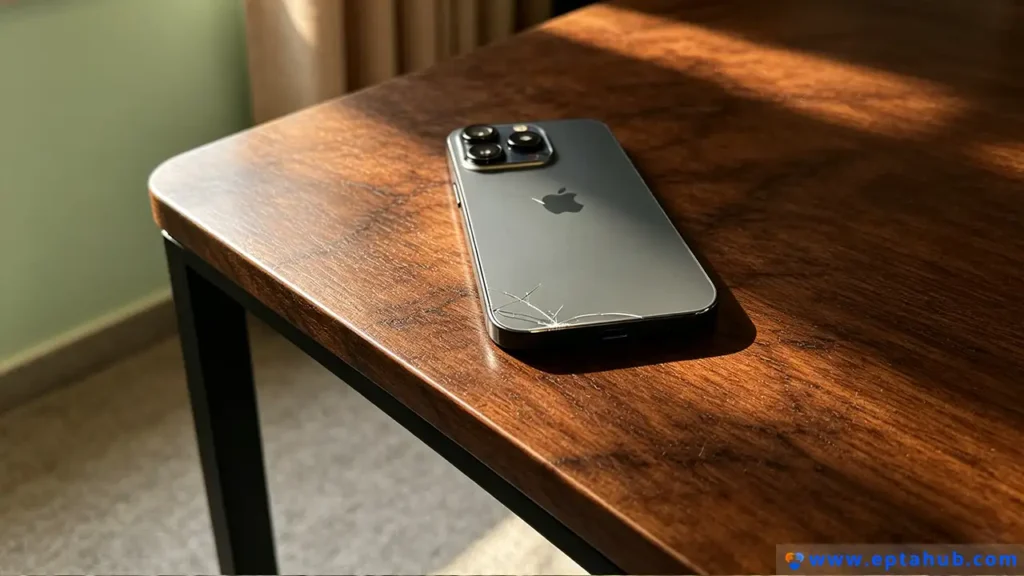
At eptahub.com, we specify materials based on their Shore Hardness and tensile strength. Here is the engineering reality of the materials you must choose from for your wholesale order.
Engineering Material Matrix: Wholesale Phone Case Resins
| Material Type | Engineering Designation | Dureté Shore | Kinetic Energy Absorption | Primary Manufacturing Method | Ideal Use Case |
|---|---|---|---|---|---|
| TPU (polyuréthane thermoplastique) | Elastomer | 70A to 95A | Excellent (Bounces/Deforms) | Moulage par injection | The global standard for clear/flexible bumper cases. High grip, low cost. |
| PC (Polycarbonate) | Amorphous Thermoplastic | 75D to 85D | Poor (Transfers Shock) | Moulage par injection | Hard structural backplates. Scratch-resistant, accepts high-resolution UV printing perfectly. |
| LSR (Liquid Silicone Rubber) | Cross-linked Elastomer | 30A to 60A | Very Good (Dampens) | Liquid Moulage par injection (LIM) | Premium, soft-touch matte cases (like official Apple cases). Requires complex, heated tooling. |
| Aramid Fiber (Kevlar) | Synthetic Polymer | N/A (Woven Matrix) | Superior (Disperses force) | Vacuum Forming / Resin Layup | Ultra-thin, ultra-premium tactical cases. Blocks RF signals if not engineered correctly. |
The Hybrid Solution: 2K Injection Molding
The industry standard for high-end custom phone cases wholesale is not a single material. It is a Hybrid PC/TPU design.
We use a process called 2K (Two-Shot) Injection Molding. A rigid Polycarbonate (PC) backplate is shot into the mold first to provide structural rigidity and a flat canvas for printing. The mold then rotates, and a soft TPU bumper is injected directly onto the edges of the PC backplate, chemically bonding the two plastics together. This gives you a rigid back for drop protection and a soft edge for impact absorption.
The Magnetic Engineering of a Custom MagSafe Phone Case
Since 2020, the most critical engineering specification a client will request is MagSafe compatibility. Many amateur designers assume they can just glue a cheap metal ring inside a TPU case and call it a Custom MagSafe Phone Case. This is a catastrophic engineering failure.
Apple’s MagSafe ecosystem is not a simple magnet; it is a highly precise, mathematically calculated Halbach Array.
- The Magnet Specification: You must specify N52 grade Neodymium (NdFeB) magnets. If you use weaker N35 or N40 magnets to save a few cents on your wholesale order, the phone will physically fall off car mounts when driving over a bump.
- The Array Geometry: The MagSafe standard requires exactly 36 individual rectangular magnets arranged in a perfect circle, plus an alignment tail.
- The Polarity Engineering: This is where cheap cases fail. The magnets cannot all face the same direction. They must alternate polarities (North-South-North-South) in a Halbach array configuration. This specific arrangement forces the magnetic flux lines outward toward the charger, concentrating the magnetic force exactly where it is needed and preventing stray magnetic fields from bleeding inward and destroying the phone’s internal compass and NFC (Apple Pay) antenna.
- The Z-Axis Tolerance: The magnetic field operates on the inverse-square law. Every millimeter of plastic between the magnet and the phone drops the holding strength exponentially. The plastic wall encapsulating the magnet array must be exactly 0.4mm to 0.6mm thick. If your injection molding tooling is sloppy and outputs a 1.0mm wall, the MagSafe feature will fail to hold the device.
Engineering Case Study: The NFC Interference Disaster
To prove why you must graduate from a basic phone case maker app to a real engineering firm, let us review a failure analysis I conducted for an e-commerce brand based in New York (who started their business by searching for how to make your own phone case nyc before scaling globally).
Le scénario : The client ordered 25,000 hybrid PC/TPU MagSafe cases from an unverified tier-3 supplier in Asia because they offered the lowest unit cost. The client received the shipment, loaded the cases with their custom artwork, and shipped them to retail customers.
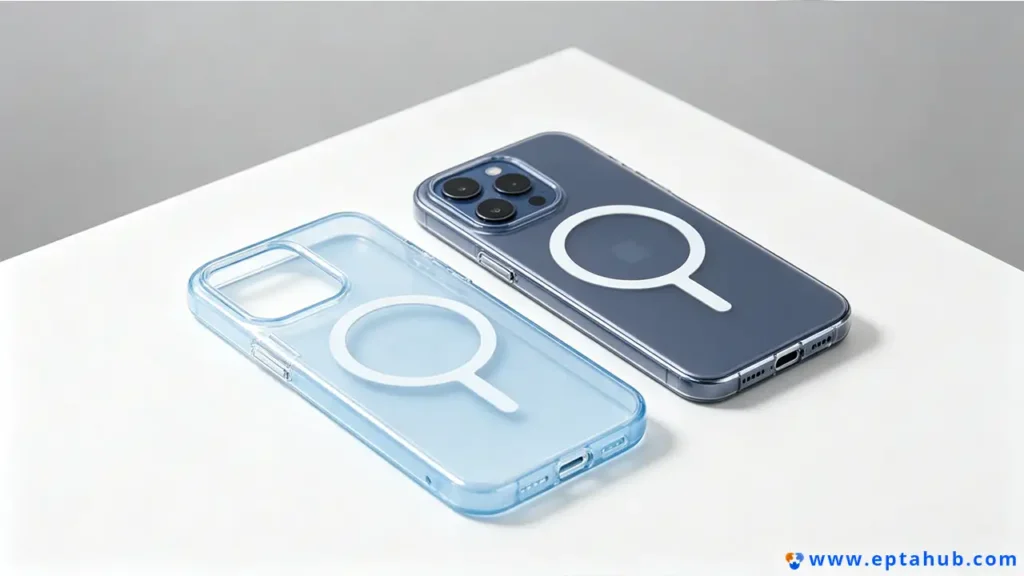
L'échec : Within two weeks, the client was hit with a 40% return rate. Customers complained that their Apple Pay (NFC) stopped working, their GPS navigation was spinning in circles, and their phone batteries were overheating on MagSafe chargers.
La cause profonde en matière d'ingénierie :
We tore down the defective cases in the eptahub.com lab. The supplier had completely ignored Apple’s MFi (Made for iPhone) magnetic design guidelines.
Instead of using 36 individual N52 magnets in a Halbach array, the cheap supplier used a single, solid stamped ring of low-grade isotropic ferrite magnet. Furthermore, they did not install a magnetic shielding layer (a thin layer of Mu-metal or nanocrystalline foil) behind the ring.
Because the magnetic flux was not controlled, massive electromagnetic interference (EMI) flooded the back of the iPhone. This stray magnetic field physically blinded the phone’s internal NFC coil (breaking Apple Pay) and disrupted the highly sensitive magnetometer (breaking the GPS compass). Additionally, because the ferrite ring was conductive but not properly aligned with the wireless charger’s induction coil, it acted as a parasitic load, absorbing the wireless charging energy and converting it into massive thermal heat, frying the phone batteries.
The Fix: We had to scrap the entire 25,000-unit batch. We re-tooled the injection mold to include a 0.5mm deep precision pocket. We sourced verified N52 Neodymium Halbach arrays, backed them with a 0.1mm nanocrystalline shielding foil to block EMI from entering the phone, and sealed them into the pocket using ultrasonic welding. The new cases passed all NFC and thermal compliance tests flawlessly.
When you buy custom phone cases wholesale, you are not buying plastic; you are buying the engineering tolerances that prevent you from destroying a $1,200 smartphone.
The Mass Production Canvas: How to Customize Phone Case with Pictures at Scale
When a startup founder wants to design your own phone case, they frequently open a browser, search for the best print on demand phone cases ou Printify phone cases, upload a JPEG, and wait for a single unit to arrive in the mail. This is retail. The ink sits completely unprotected on the surface of the plastic and will scratch off the moment it shares a pocket with a set of car keys.
When you transition to ordering custom phone cases wholesale, you cannot rely on the basic desktop inkjet technology found in a consumer phone case maker kit. At eptahub.com, we must mathematically guarantee the adhesion coefficient of the ink to the polymer substrate over tens of thousands of units.
If your goal is to customize phone case with pictures at an industrial scale, you must specify one of the three following highly controlled manufacturing processes.
1. UV Flatbed Printing (The Mid-Volume Workhorse)
For batches ranging from 500 to 5,000 units, industrial UV printing is the standard. Large flatbed CNC gantries jet microscopic droplets of CMYK+White ink directly onto the Polycarbonate (PC) or TPU backplate.
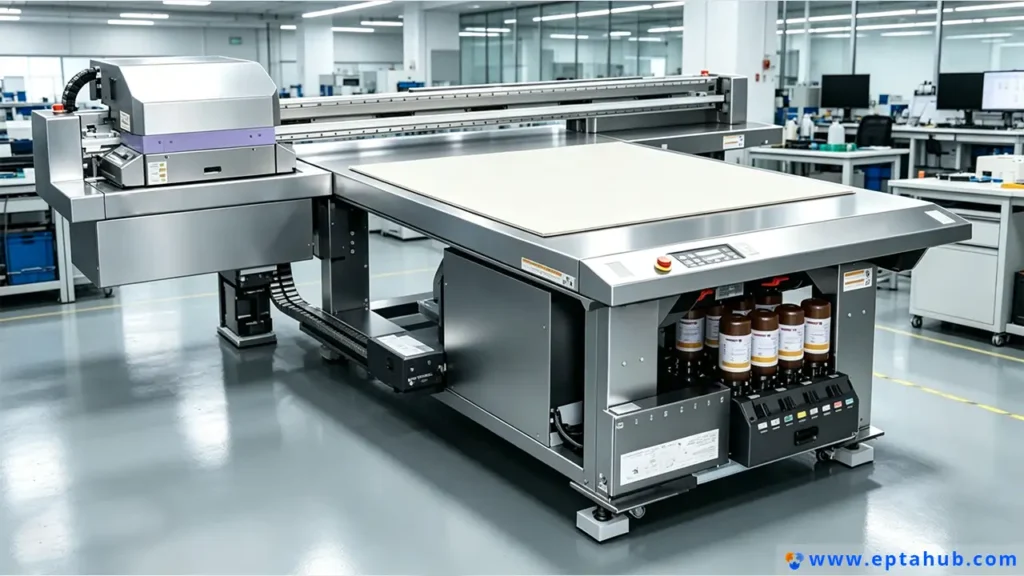
- La physique : Milliseconds after the ink hits the plastic, a high-intensity Ultraviolet (UV) LED array passes over it. The UV radiation causes a photochemical reaction, instantly cross-linking the ink monomers into a solid polymer layer.
- The Engineering Challenge: UV ink is inherently rigid. If you print a thick graphic on a highly flexible TPU case, the ink will inevitably crack when the case is bent. To prevent this, we must specify a chemical adhesion promoter (primer) spray prior to printing, and specifically formulate “flexible” UV inks to match the Shore Hardness of the TPU substrate.
2. 3D Vacuum Sublimation (The Full-Wrap Retail Standard)
If your design requires the graphic to wrap completely around the curved edges of the phone case, standard flatbed UV printing will fail. We must use 3D Sublimation.
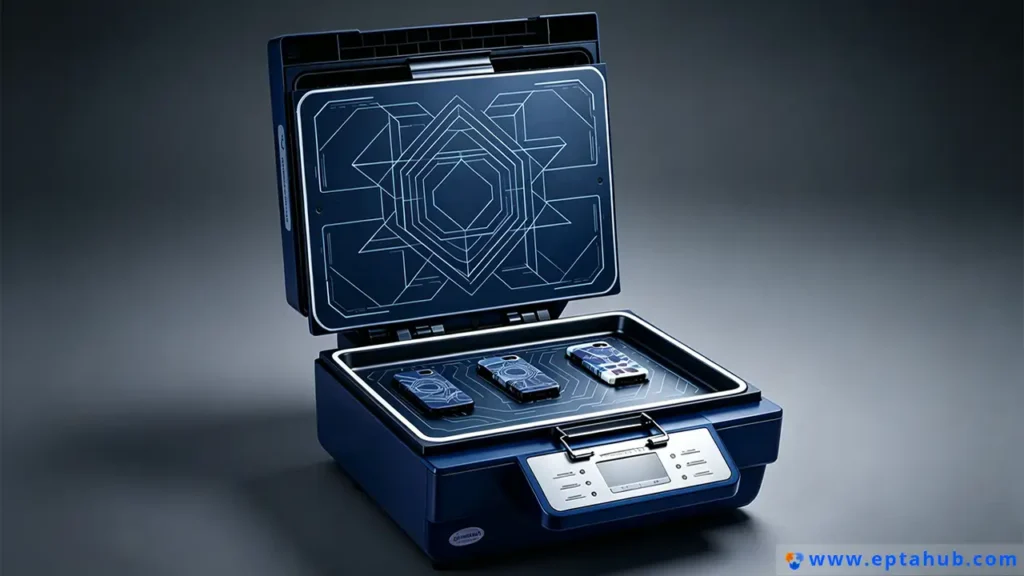
- La physique : The graphic is printed backward onto a special transfer film. The blank phone case (specifically engineered with a sublimation-receptive coating) is placed into a vacuum heat press. The machine draws a hard vacuum, pulling the film perfectly tight against the 3D curves of the case, and blasts it with 200°C heat.
- The Reaction: At this precise temperature, the solid ink instantly vaporizes into a gas (sublimation) and physically permeates the molecular structure of the plastic coating. The graphic is not on the case; it is permanently dyed dans the case. It cannot be scratched off.
3. In-Mold Decoration (IMD) / In-Mold Labeling (IML) (The Engineering Pinnacle)
When massive global brands order 100,000+ units, they do not print on the cases after they are manufactured. They print during the injection molding process.
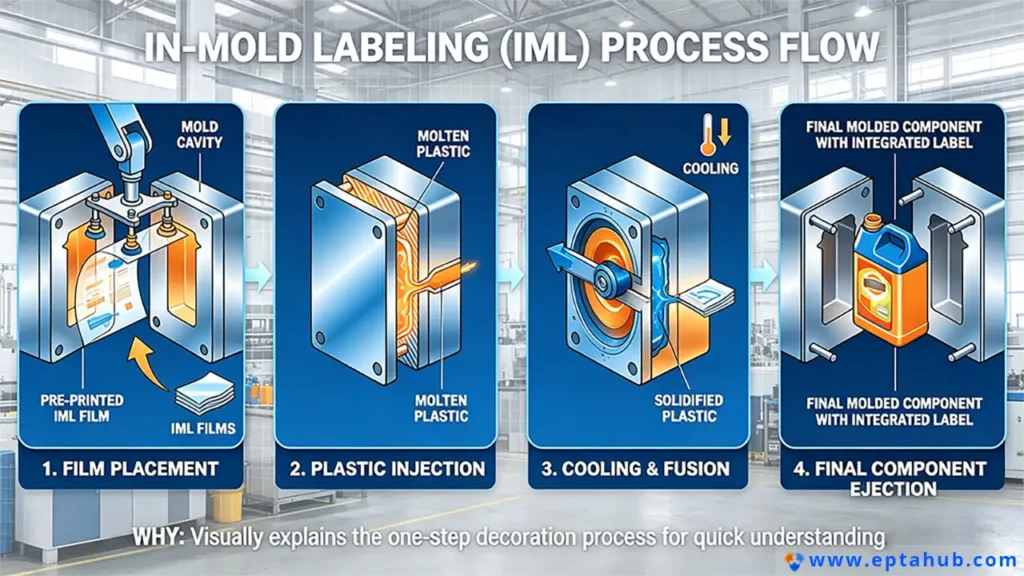
- La physique : The high-resolution graphic is printed onto a massive roll of thin, clear PET film. A robotic arm cuts the film, places it directly inside the open cavity of the P20 steel injection mold, and closes the tool. Molten Polycarbonate is then injected into the mold at 15,000 PSI behind the film.
- Le résultat : The immense heat and pressure permanently fuse the plastic resin and the printed film together into a single, indestructible component. The graphic is buried underneath a protective layer of clear PET. It is immune to scratches, UV fading, and chemical solvents. This is the absolute highest tier of custom phone cases wholesale manufacturing.
Engineering Matrix: Surface Decoration Technologies
| Manufacturing Technology | Best For… | Unit Volume Suitability | Graphic Durability | Engineering Drawbacks |
|---|---|---|---|---|
| UV Flatbed Printing | Flat PC/TPU Backplates, Embossed text. | Low to Medium (500 – 5,000) | Moderate (Surface level) | Prone to scratching if not clear-coated. Ink cracks on highly flexible TPU. |
| 3D Sublimation | Edge-to-edge full wraps, vibrant gradients. | Medium (1,000 – 10,000) | Very High (Infused into polymer) | Only works on specific heat-resistant, coated hard plastics. Cannot be used on soft TPU. |
| IMD / IML | Indestructible graphics, massive retail rollout. | High (50,000+) | Absolute (Buried under PET) | Extremely high initial tooling costs. Cannot easily change the graphic once the mold is set. |
Structural Complexity: The Personalised Phone Case Wallet
When graduating from simple plastic shells to complex textile assemblies, such as a personalised phone case wallet (or folio case), the Bill of Materials (BOM) explodes in complexity.
You are no longer just dealing with an injection molder; you are dealing with a cut-and-sew operation.
Many amateur designers assume a wallet case is just a plastic shell with some leather glued to it. If you use standard cyanoacrylate (Superglue) to bond PU (Polyurethane) leather to a TPU chassis, the bond will catastrophically fail under the dynamic thermal cycling of a hot smartphone battery.
At eptahub.com, we mandate High-Frequency (RF) Welding.
Instead of relying on chemical adhesives or physical stitching (which creates perforations and weak points in the material), we clamp the PU leather and the TPU chassis between two metal dies. We blast the assembly with high-frequency electromagnetic radio waves (typically 27.12 MHz). This excites the molecules in the plastic, melting them together internally to form a permanent, seamless weld. This is how premium waterproof wallet cases achieve a zero-fail rate.
The Financial Engineering: Mold Amortization and True Cost
Let us return to the destructive internet search: “custom casing phone online free wholesale”.
As a manufacturing engineer, I must explain the concept of NRE (Ingénierie non récurrente) costs. True wholesale manufacturing requires custom steel tooling. A multi-cavity P20 steel injection mold for an iPhone 15 Pro case costs between 3,500and8,000 USD to machine, polish, and test.
There is no factory on earth that will give you this “for free.”
However, the mathematics of mass production heavily favor the investor who understands Tooling Amortization.
- If you rely on a middleman (like Printify) to print on pre-made blanks, you might pay $6.00 per unit forever.
- If you order 50,000 units, your tooling cost is mathematically amortized to just 0.10percase.Yourtotalunitcostdropsto∗∗0.50**.
That is true wholesale. By controlling the exact chemical composition of the mold, you strip away the middleman markup and gain absolute engineering authority over the product.
The Engineer’s Verdict: Stop Buying Blanks, Start Engineering
The global market for mobile accessories is saturated with millions of identical, poorly printed, low-grade TPU blanks sourced from dropshippers.
If you want to build a brand that survives, you must stop acting like a retail consumer searching for a phone case maker app. You must act like a mechanical engineer.
- Mandate Hybrid 2K molding (PC + TPU) for kinetic energy dispersion.
- Strictly enforce Apple’s Halbach Array guidelines for any Custom MagSafe Phone Case, utilizing N52 Neodymium magnets and nanocrystalline shielding.
- Choose your decoration technology (UV, Sublimation, or IMD) based on strict durability requirements and production volume, not just convenience.
At eptahub.com, we don’t just “make phone cases.” We engineer protective micro-environments for highly sensitive, expensive electronics. Treat your supply chain with that level of respect, and your product will dominate the market.
Références
To ensure your wholesale production runs meet global consumer safety and functional requirements, mandate compliance with the following engineering standards:
1.ASTM D3363 (Standard Test Method for Film Hardness by Pencil Test)
The industrial standard for verifying the scratch resistance of your UV-cured inks and IMD clear coats. If your case supplier cannot provide a Pencil Hardness report (e.g., 2H or 3H), the graphics will fail in the field.
Lien: ASTM.org
2.ISO 10993 (Biological Evaluation of Medical Devices – Cytotoxicity & Sensitization)
Because a phone case is in constant physical contact with human skin for 12 hours a day, premium wholesale buyers must ensure the TPU resins and UV inks pass basic biocompatibility tests to prevent widespread allergic reactions or chemical burns.
Lien: ISO.org