Top-Tier Powder Coating Solutions Delivered in Days, Not Weeks | Subject to Availability. EPTAHUB does not guarantee the availability of this service at any specific time.
STEP丨STP丨SLDPRT丨STL丨IPT丨3MF丨3DXML丨PRT丨SAT
EPTAHUB provides powder coating as a value-added, all-in-one service that complements our core manufacturing capabilities, such as CNC machining, 3D printing, injection molding, casting, and sheet cutting. Customers can fully customize their products using the EPTAHUB Instant Quoting Engine®. Please note that EPTAHUB generally does not offer secondary processing or finishing for parts supplied by third parties, though there may be rare exceptions.
EPTAHUB's powder coating services come in a diverse range of colors, finishes, and material options. Our process applies a consistent, protective colored layer to parts using evenly distributed, heat-cured coating materials available in hues like red, orange, blue, black, and numerous others. We also offer various finish textures including matte, gloss, and textured surfaces. This powder coating creates a long-lasting, vivid finish for metals such as aluminum and steel, safeguarding them against weathering, water damage, impacts, and other forms of stress. Its applications are widespread, covering kitchen appliances, automotive components, lawn and garden equipment, architectural and construction materials, drum hardware, bicycle parts, and many more.
Powder coating is a surface protection technique that involves applying dry, electrostatically charged particles—typically made of thermoset or thermoplastic polymers—to a grounded surface using a specialized spray gun. This creates a thin, uniform layer. After application, the coated surface is heated and cured to fuse the powder into a durable finish. Beyond enhancing aesthetics with vibrant colors, powder coating effectively shields metal surfaces from corrosion, scratches, and other types of damage.
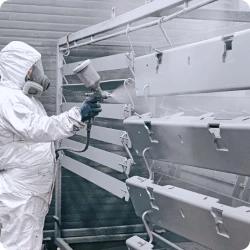
Unlike traditional liquid coating methods, powder coating is achieved through a multi-stage process. The standard steps of the powder coating workflow typically include:
First, polymers, hardeners, colorants, and other additives are mixed together in a specialized mixer. This mixture is then extruded, allowed to harden, and broken into small fragments. These fragments are subsequently milled into a consistent, flour-like fine powder that ensures uniform application.
The surface to be coated is thoroughly cleaned and prepared by removing dirt, oils, and other contaminants. This preparation may involve sandblasting, chemical degreasing, or other mechanical and chemical treatments tailored to metal surfaces. For heat-sensitive substrates, additional pre-treatment steps may be required to ensure compatibility. Removing all contaminants is crucial to achieving a smooth, high-adhesion coating.
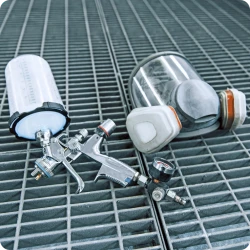
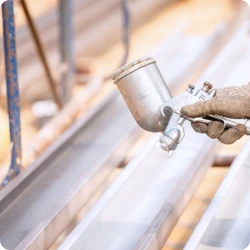
The dry powder is applied using electrostatic spray deposition (ESD), where the powder particles are charged (usually to -30 to -90 kV) via a spray gun. The grounded part attracts these charged particles, ensuring even adhesion across the surface. Application methods vary based on part complexity and volume: manual spray guns are used for intricate shapes requiring precise control, while robotic automatic guns handle high-volume production for consistent coverage. The process takes place in a spray booth with controlled airflow to recover and reuse overspray, boosting material efficiency to approximately 95%.
The coated parts are placed in a curing oven, where they are heated to a specific temperature—typically 180-200°C for 10-20 minutes, though low-bake options (as low as 150°C) are available for heat-sensitive materials. During this stage, the powder melts, flows into a smooth layer, and undergoes a chemical cross-linking reaction (for thermoset powders) to form a hard, durable film. The curing process is carefully controlled to ensure full polymerization and optimal finish quality.
EPTAHUB's rigorous quality control process ensures every coated part meets the highest standards. Inspections include: thickness measurement using magnetic or eddy-current gauges (typically 60-120 μm); adhesion testing per ASTM D 3359 (cross-hatch/cut tape method); visual inspection for defects like orange peel, pinholes, or runs; and gloss/color verification using a spectrophotometer. We also adhere to industry specifications such as ASTM D 7803, MIL, and FDE when required.
The finish of powder-coated components mirrors the range of traditional paint, spanning from dead-matte to full-gloss appearances—all determined by the specific polymer blend and application process used. EPTAHUB’s powder coating services default to standard matte finishes for coated parts, unless alternate specifications are noted in your order quote. For custom finish requirements, reach out during the quoting phase: our fabricators will ensure the exact finish you need is achieved.
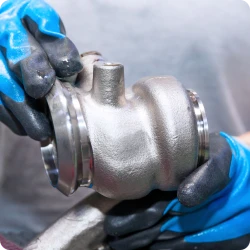
Below is a list of materials commonly compatible with powder coating. EPTAHUB will collaborate closely with you to pair the right material and finish, even if your intended material isn’t listed here:
In the H32 temper, 5052 aluminum is a high-strength, corrosion-resistant alloy ideal for general applications (like sheet metal) and specialized uses: marine/transportation products, fuel tanks, architectural elements (gutters, window frames), and more.
The T6-tempered 6061 aluminum is a strong, lightweight, and machinable alloy. It’s widely used to produce structural components for aerospace parts, automotive components, recreational gear, and construction projects.
7075 aluminum (T6 temper) is an ultra-high-strength, fatigue-resistant alloy. It’s designed for high-stress structural parts—such as aerospace gears, shafts, aircraft fittings, and components for extreme environments.
MIC6 is a branded cast aluminum alloy plate (manufactured by Alcoa) commonly used for tooling, base plates (for automotive/aerospace components), and jigs/fixtures.
These abrasion-resistant (AR) steels are high-hardness materials built to withstand heavy wear. They’re used for body armor, ballistic plates, shooting targets, and in construction/mining equipment.
4140 and 4130 chromoly (low-alloy) steels get their “40”/“30” designations from 0.40%/0.30% carbon content, respectively. They offer excellent strength-to-weight ratios, tensile/fatigue strength, and machinability—making them ideal for structural/mechanical parts (e.g., automotive components, oil/gas tubular products).
This corrosion-resistant stainless steel (high in chromium/nickel) suits diverse uses: food processing equipment, kitchen tools, medical instruments, construction/automotive parts, and architectural features (window frames, etc.).
316 stainless steel (high molybdenum, lower carbon than 304) boasts exceptional corrosion resistance. It’s perfect for marine settings, medical implants, chemical processing gear, and high-wear construction/architectural applications.
A36 is a low-carbon steel with strong formability and weldability. It’s used for structural components (tanks, welded bridges), building construction, automotive parts, and fabricated products (pipes, rods, beams).
Formed by rolling at temperatures over 1700°F, hot rolled steel is strong and malleable. It’s used for structural bars, sheet metal, and stock for piping, beams, and automotive parts.
Tool steel is a high-carbon, high-alloy material engineered for tool manufacturing. Its heat-treatability and wear resistance make it ideal for punches, dies, cutting edges, hand tools, power tool bits, and automotive parts.

Key advantages of powder coating include:
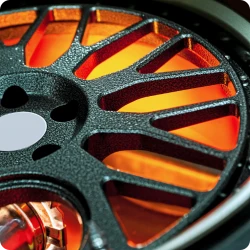
Powder coating creates a protective layer more resistant to wear, abrasion, and corrosion than liquid coatings. It also extends material lifespan: it’s less prone to chipping, peeling, or fading.
Enhanced AestheticsPowder coating delivers a smooth, uniform finish that elevates a material’s appearance. It can be applied in a wide range of colors and finishes.
Environmental FriendlinessAs a dry process, powder coating produces no volatile organic compounds (VOCs) or harmful emissions—making it a greener alternative to liquid coatings.
Cost-EffectivenessPowder coating often costs less than liquid coatings: it uses less material and generates less overspray, reducing material and disposal expenses.
Powder coating works for most products (it relies on dry particles adhering to a grounded surface). Common examples include:
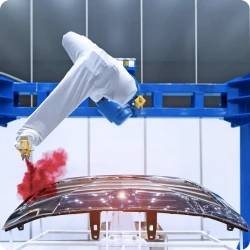
Powder coating suitability depends on material properties and application processes. Some materials require special pre-treatment, but these categories generally cannot be powder coated:
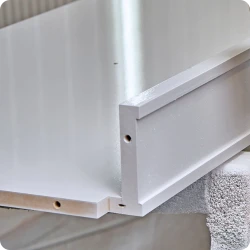
When powder coating a product, keep these key design factors in mind:
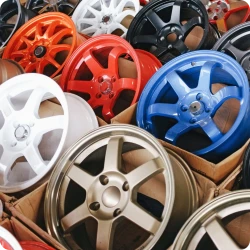
A typical powder coat adds 0.006”–0.12” of surface thickness, which can disrupt tight-tolerance builds or through-hole diameters. Coat thickness must match the part’s intended use: too thin offers insufficient protection; too thick may warp tolerances or create uneven surfaces.
Material SurfacePorous surfaces may need special primers/treatments for proper adhesion. All surfaces must be degreased, cleaned of contaminants, and kept dry/smooth for optimal results.
ColorColor impacts a part’s final appearance. Ensure consistent coating methods/powders: different blends yield different colors, which can cause mismatches and inconsistency.
CostWhile economical, powder coating costs vary by part size/complexity, finish, and color. Complex parts may require more labor/time (plating may be more resource-efficient in some cases).
Learn how to easily obtain an instant quote for Powder Coating services through the EPTAHUB Instant Quoting Engine®.
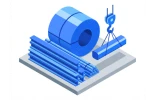
Select from millions of combinations of materials, finishes, tolerances, markings, and certifications for your order.

Quickly get instant quotes for powder coating with our user-friendly quoting system.

We hold ISO 9001:2015, ISO 13485, and AS9100D certifications.
 English English
  German
 Spanish
 French
 Japanese
 Korean
 Malay
Malay
 Portuguese
 Russian
 Thai
Thai
Our automated quoting system gives you instant pricing so you can quickly estimate your project costs.
For high-precision or complex parts, our senior account managers can provide more detailed quotes and help you find the best overall solution for your needs.