Home / Vapor Smoothing 3D Printed Parts

Vapor Smoothing 3D Printed Parts

EPTAHUB’s vapor smoothing service offers low-cost finishing for additive-manufactured parts, delivering a surface finish that can compete with injection molding.

Instant 3D Printing Quotation (Icon 1) Instant 3D Printing Quotation (Icon 2) Instant 3D Printing Quotation (Icon 3)

Quote Start A New 3D Printing

STEP丨STP丨SLDPRT丨STL丨IPT丨3MF丨3DXML丨PRT丨SAT

Vapor Smoothing 3D Printed Parts

3D printing is one of the primary methods for small-batch product manufacturing. However, plastic 3D printing typically has a significant drawback: the surface finish of parts is often poor. Powder bed fusion processes—such as Selective Laser Sintering (SLS) and HP Multi Jet Fusion (MJF)—produce a matte, grainy texture similar to a sugar cube. Fused Deposition Modeling (FDM), in contrast, leaves visible layer lines on the surface. Over the past 30 years, traditional post-processing methods such as media tumbling, manual sanding, and coating have only achieved limited improvements in surface quality. As a result, when aesthetics are critical, engineers often choose alternative manufacturing methods such as injection molding, CNC machining, or polyurethane casting.

With the development of chemical vapor smoothing—a technique that uses vapor-phase solvents to smooth the surface of 3D-printed parts and improve their mechanical properties—plastic 3D printing has become much more suitable for low-volume production. This process is compatible with most 3D-printable polymers and elastomers, including more than twenty materials offered by EPTAHUB.
What Is Chemical Vapor Smoothing?

EPTAHUB has adopted AMT’s PostPro3D chemical vapor smoothing technology. Unlike physical smoothing processes like sanding or media tumbling, vapor smoothing does not remove material from the workpiece. Instead, a vapor finishing agent (FA 326) is placed into a sealed processing chamber along with the parts. Although the finishing agent remains the same, different processing parameters are applied based on the materials and geometric features of the parts. Parts are racked or hung in a 600 x 400 x 400 mm chamber to maximize the exposure of their surfaces to the vapor. The vapor adheres to the part surface, where it causes a controlled chemical melt. This melt reduces the surface peaks and valleys by liquefying and redistributing the material, creating a more even surface. Additionally, the melt has the effect of enhancing the part’s shine.

Once the parts are finished, the chamber is heated to extract the finishing agent into a collection vat. No residue is left on the parts. The smoothed parts are then ready for shipping or for another secondary process, such as dyeing.
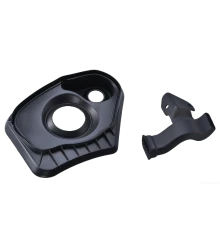
Chemical vapor smoothing process transforming raw 3D printed surfaces into smooth, sealed, and glossy finishes

What 3D Printed Materials Can Be Vapor Smoothed?

Compatible Materials for Chemical Vapor Smoothing through EPTAHUB

Material Name Process Quoting Process
Nylon 12 SLS, HP MJF Instant Quote
Nylon 12, Glass Bead SLS, HP MJF SLS, HP MJF
Nylon 11 HP MJF Instant Quote
Thermoplastic Urethane, TPU 88A HP MJF Instant Quote
Polypropylene (PP) HP MJF Requires Review
Nylon 11 EX SLS Requires Review
Nylon 12, Carbon-Filled (CF) SLS Requires Review
Nylon 12, Aluminum-Filled (AF) SLS Requires Review
Nylon 12, Mineral-Filled (HST) SLS Requires Review

The table above lists all the materials that EPTAHUB offers for vapor smoothing, including those that may need a manual review. You can get an instant quote for select materials by selecting "Vapor Smoothing" from the "Finishes" drop-down menu.
Promotional banner for custom 3D printed parts featuring a free shipping offer

Choosing The Right 3D Printing Process?

Easily compare 3D printing processes with our quick reference guides.
How Much Does Vapor Smoothing Cost?

You can obtain instant pricing and lead times for vapor smoothing through the EPTAHUB Instant Quoting Engine®. These are determined by the process, material, quantity, and part geometry for the most popular HP MJF and SLS materials. Since the process is batch-based, the cost per part is relatively low and will decrease as the order volume increases. EPTAHUB typically adds 1-5 business days to the lead times for vapor smoothing.

For vapor smoothing orders involving specialty materials like SLS high-performance blends, Nylon 11 EX, Nylon 12 AF, Nylon 12 HST, and Nylon 12 CF, EPTAHUB will conduct a manual review. Please select “Other” as your finish option and submit the quote for an expert review.

Cost-benefit analysis of vapor smoothing for 3D prints, balancing automated finishing with industrial part value

The Benefits Of Vapor Smoothed 3D Prints

Vapor smoothed parts have improved cosmetic appeal and their surface finish is comparable to that of injection molding. Standard SLS parts usually have a surface roughness of more than 250μin Ra, but with chemical vapor polishing, this can be improved to below 125μin Ra and as low as 40μin Ra. In some studies, chemical vapor smoothing has enhanced material surfaces by 800%-1000%. It is important to note that chemical vapor smoothing redistributes surface material to create a sealed, smooth surface – it does not produce a polished surface. There will still be visible surface topology and minimal layer lines.

Chemical vapor smoothing can greatly increase the practicality of 3D prints in food processing, medical devices, and consumer products. It is recommended for end-use applications in these industries. Notably, vapor-smoothed nylon 12 3D prints effectively reduce bacterial attachment and growth compared to standard nylon 12 3D prints. Studies have shown that vapor-smoothed SLS and HP MJF parts meet and pass multiple biocompatibility and safety tests.

Other benefits of chemical vapor smoothing include:

Enhanced 3D printed parts showing improved elongation at break, airtight sealing, and aesthetic surface quality

Chemical Vapor Smoothing For Health And Safety Products

Vapor Smoothing Passes Health and Safety Tests

The chemical used for vapor polishing is safe, and the closed-loop process of AMT’s PostPro3D system ensures that no extra residue remains on the parts after smoothing. In fact, studies have demonstrated that vapor-smoothed SLS and HP MJF parts comply with and pass multiple biocompatibility and safety tests related to food contact, skin irritation, cytotoxicity, and bacterial growth. The results are summarized above, and more details can be found in this AMT PostPro3D document on safety certifications.
Test Results Details Normative Reference
Food Contact Test PASS SLS printed PA-12 parts chemically vapor smoothed with PostPro3D do not pose a risk to consumer health or affect food quality. According to regulation (EC) 10/2011 Annex V, Chapter 3, Table 3, OM 3, 2 hours at 70°C; DS/EN1186-01:2002; DS/EN1186-03:2002; DS/EN1186-14:2002
Skin Irritation Test PASS SLS printed PA-12 parts chemically vapor smoothed with PostPro3D did not cause skin irritation. ISO 10993-10 (2013); ISO 10993-1 (2018); OECD TG 439
Cytotoxicity Test PASS MJF printed PA-12 parts chemically vapor smoothed with PostPro3D did not cause a cytotoxic effect. ISO 10993-5 (2009); ISO 10993-1 (2010); ISO 10993-12 (2012)
Microbiological Test on MRSA Bacteria PASS MJF printed PA-12 parts chemically vapor smoothed with PostPro3D showed a 99.88% reduction in bacterial growth against MRSA. MOD ISO 22196: 2011
Microbiological Test on E. coli Bacteria PASS MJF printed PA-12 parts chemically vapor smoothed with PostPro3D showed a 99.78% reduction in bacterial growth against E. coli. MOD ISO 22196: 2011

Design Tips For Vapor Smoothing 3D Prints

Design guidelines for vapor smoothing including vent hole placement and geometry considerations for uniform finishing

Applications For Vapor Smoothing

Promotional banner for custom 3D printed parts featuring a free shipping offer

Concept Models

Enhanced cosmetics, better coloration, and sealed surfaces can make vapor smoothed 3D prints stand out as impressive concept models.
Solid 3D printed conceptual model used for design iteration and solid modeling

Rapid Prototyping

Vapor smoothing does not significantly extend lead times, enabling the production of highly functional parts in record time

High-precision plastic 3D printed components arranged for large-scale direct digital manufacturing

Direct Digital Manufacturing

3D printing vapor smoothing is a bulk finishing process, making it an ideal solution for producing large quantities of customized parts.

logo200

Start Your Project Today. Upload Your File For An Instant 3d Printing Quote.

Real Time Quotation Demonstration

Learn how to use the EPTAHUB (instant Quoting Engine @) Quickly and easily obtain 3D printing quotes.
Why Choose EPTAHUB For 3D Printing?

Diverse selection of 3D printing materials, surface treatments, and certifications

Endless Options

Select from millions of possible combinations of materials, finishes, tolerances, markings, and certifications for your order.

Logistics icon symbolizing direct doorstep delivery of managed 3D printing projects

Easy To Use

Have your parts delivered right to your door, without the hassle of sourcing, project management, logistics, or shipping.

ISO 9001 and IATF 16949 certification logos for 3D printing quality assurance

Certified Network

We hold ISO 9001:2015, ISO 13485, and AS9100D certifications.
×

EPTAHUB Professional & Intelligent Quoting

Our automated quoting system gives you instant pricing so you can quickly estimate your project costs.

For high-precision or complex parts, our senior account managers can provide more detailed quotes and help you find the best overall solution for your needs.

Get Instant Quote Get a Quote Instantly — ⭐⭐⭐
Request Expert Quote Precise Quotes — ⭐⭐⭐⭐⭐