With our advanced technologies and materials, 3D printing can be used directly for producing end-use parts in production quantities.
STEP丨STP丨SLDPRT丨STL丨IPT丨3MF丨3DXML丨PRT丨SAT
Design resource support, Mold-free production with 3D printing
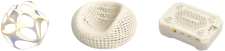
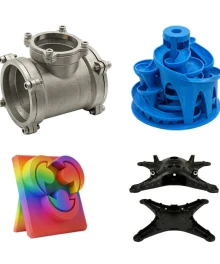
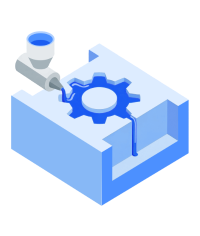
At EPTAHUB, you have access to advanced 3D printing technologies such as Multi Jet Fusion and Carbon DLS™, which offer industry-leading printing speed and quality. Combined with a wide range of material options—from regular thermoplastics to engineering-grade photopolymers, and you can create parts that can adapt to end-use scenarios and environments. By using production printing technology, there is no need to invest in expensive tools or molds, and you can obtain the required parts faster at a more economical cost compared to traditional production processes like injection molding.
Our production-grade processes are suitable for manufacturing parts in various industries, including:
Learn about the applicable scenarios and selection criteria of the two processes in plastic part production.
Additive manufacturing processes suitable for production share some common characteristics. A crucial point in production scenarios is the ability to manufacture a large number of parts simultaneously, which means technologies with larger build volumes, nestable parts, and high-speed printing capabilities are more suitable for production work. Material selection is also a key consideration: many processes are good at prototyping, but the materials used cannot meet the requirements of end-use applications. For example, popular photopolymer printing technologies such as Stereolithography (SLA) and PolyJet can create prototypes with rich details or highly realistic concept models, but the resins they use have relatively poor toughness compared to other materials on the market.
It should be noted that not all parts are suitable for mass production through 3D printing. Generally, small parts with a maximum size of no more than a few inches are more suitable - such parts can accommodate a larger number in a single build. Parts with wide planar geometric structures are prone to warping during the printing process, making it difficult to ensure quality and consistency in large-scale production. EPTAHUB's professional team can assist in reviewing your project and provide the most suitable solution for your needs.
The following sections will detail the specific processes we offer and recommend for 3D printing production:
Like all powder bed 3D printing processes, Multi Jet Fusion builds parts by stacking layers, but the working principle of this technology is closer to that of traditional inkjet printers: the print head first deposits materials, and then sprays heat-activated fusing agents. These two steps are completed at once on the entire build platform, allowing multiple parts to be printed simultaneously, with a speed up to 10 times faster than Selective Laser Sintering (SLS) and other 3D printing processes.
Compared with SLS, parts manufactured by Multi Jet Fusion technology have more balanced mechanical properties in the X, Y, and Z axes. With the advantages of high cost-effectiveness, high speed, and high resolution, this technology can be used for small-batch production of end-use applications, rapid prototyping, or as a transitional process for injection molding. Although the material selection range of Multi Jet Fusion technology is not as wide as that of some other production processes, it already covers commonly used popular materials such as Nylon, Polypropylene, and Thermoplastic Polyurethane (TPU).
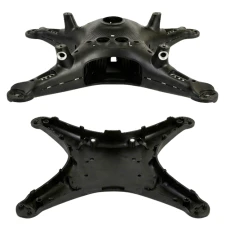
High-quality prototypes and production parts can be delivered within 1 day. Certified to ISO 9001:2015, ISO 13485, IATF 16949:2016, AS9100D.
Selective Laser Sintering (SLS) is another type of powder bed 3D printing technology that can manufacture high-precision and high-toughness parts, which can be directly used for small-batch production of end-use applications. This process heats the material to near its melting point and then uses a laser to precisely fuse powder particles to build parts layer by layer.
The key reason why SLS technology is suitable for production is its ability to nest parts densely within the build volume, and its ability to handle larger geometric structures is better than that of MJF technology. Although SLS is mainly suitable for polyamide-based materials, it offers a wide range of options — covering general-purpose and engineering-grade materials. The finished parts are usually off-white and can be customized with various colors through dyeing.
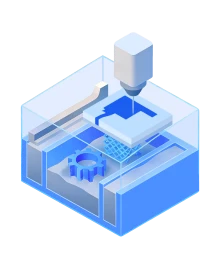

High-quality prototypes and production parts, with 1-day expedited delivery available. Certified to ISO 9001:2015, ISO 13485, IATF 16949:2016, AS9100D.
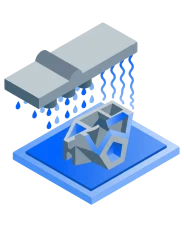
Carbon technology combines digital light projection, oxygen-permeable optics, and programmable liquid resins to produce products with end-use toughness, resolution, and surface finish. Unlike most additive manufacturing processes that print in discrete layers, the Digital Light Synthesis process uses continuous printing, which gives parts isotropic properties — meaning strength is not affected by the printing direction.
Carbon DLS™ materials are based on polyurethane or epoxy resins and have excellent mechanical properties. Among them, elastomers and silicone materials perform better than most additive manufacturing rubber-like materials. By activating dormant epoxy resins or polyurethanes through secondary thermal processing, the material performance can far exceed the effect of simple UV curing. Combined with Carbon's custom liquid resins, this technology breaks the limitations of traditional manufacturing and provides possibilities for new business models and product designs such as large-scale customization and on-demand inventory of end products.


High-performance prototypes and serialized production parts.
In FDM technology, the filament of the selected material is precisely controlled by a motor and fed into a print head (equipped with an extruder and a nozzle) mounted on a gantry; the filament is heated to a molten state in the print head, and then precisely extruded through the nozzle, deposited layer by layer on the build platform, filling the cross-section of the part, and finally completing the part manufacturing.
Although the printing speed of FDM technology is not as fast as that of DLS™, and the part nesting efficiency is not as good as that of MJF, its build area provides a unique advantage for production printing — the maximum build volume can reach 24 inches × 36 inches × 36 inches (approximately 610mm × 914mm × 914mm), and depending on the part size, dozens or even hundreds of parts can be accommodated in a single build. In addition, among all 3D printing processes, FDM has an extremely wide range of material options, covering various thermoplastics from general-purpose to engineering-grade.
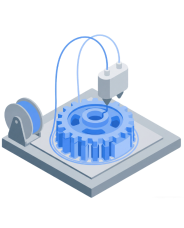
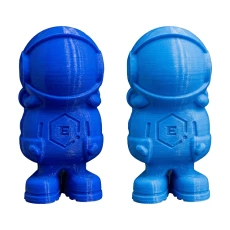
High-quality large-format FDM 3D printing, with 1-day expedited delivery available. International prototype order quotes include customs duties.
International prototype order quotes include customs duties, learn more details!
EPTAHUB has a rich range of materials suitable for production parts, including special engineering resins, thermoplastics, and high-toughness materials, all designed for actual end-use applications. The characteristics and performance of various materials vary significantly, which can meet the customized needs of your different projects. The table below lists our standard production material options to help you select the most suitable material for your project.
Learn how to use the EPTAHUB (instant Quoting Engine @) Quickly and easily obtain quotes.
Select from millions of possible combinations of materials, finishes, tolerances, markings, and certifications for your order.

Have your parts delivered right to your door, without the hassle of sourcing, project management, logistics, or shipping.

We hold ISO 9001:2015, ISO 13485, and AS9100D certifications.
 English English
  German
 Spanish
 French
 Japanese
 Korean
 Malay
Malay
 Portuguese
 Russian
 Thai
Thai
Our automated quoting system gives you instant pricing so you can quickly estimate your project costs.
For high-precision or complex parts, our senior account managers can provide more detailed quotes and help you find the best overall solution for your needs.