Top-Tier Precision Grinding Services Turnaround In Days, Not Weeks. Availability Is Subject To Change, And EPTAHUB Cannot Assure The Provision Of This Service At Any Specific Moment
STEP丨STP丨SLDPRT丨STL丨IPT丨3MF丨3DXML丨PRT丨SAT
Precision grinding, much like other grinding techniques, utilizes an abrasive material to strip tiny material fragments from a workpiece. This process centers on creating extremely flat, smooth surfaces while adhering to exceptionally tight dimensional tolerances.
EPTAHUB’s high-quality precision grinding services have gained traction with clients across diverse industries such as automotive, aviation, bearing, electrical, and medical. The company provides four distinct precision grinding service options: cylindrical grinding, centerless grinding, internal grinding, and surface grinding (corrected from "spindle grinding").
Similar to all grinding techniques, precision grinding makes use of an abrasive substance to strip away small fragments of material from a workpiece. Its primary focus lies in crafting extremely flat and smooth surfaces while adhering to extremely strict tolerance requirements. As a finishing procedure in the manufacturing sector, precision grinding is a cost-efficient and dependable approach to achieving accurate tolerances and impeccable surface finishes for manufactured components.
This process is frequently utilized to meet highly precise tolerances, some as tight as +0.00025 inches. Moreover, it is often employed to attain polished surface finishes on parts. Precision grinding can serve as either a final finishing step or a preparatory process for other subsequent finishing methods such as honing, lapping, and superfinishing.
The achievement of precise dimensions and desirable surface finishes in precision grinding is made possible through the use of various abrasives, including aluminum oxide, silicon carbide, and diamond. The selection of the abrasive type depends on the material of the workpiece. For instance, aluminum oxide abrasives are most suitable for grinding steel and other ferrous metals, whereas silicon carbide abrasives perform better with non-ferrous metals. Although grinding can be done manually using equipment like belt grinders and angle grinders, CNC automated grinding delivers superior outcomes in terms of efficiency and surface quality.
EPTAHUB provides four main categories of precision grinding services, which are widely applied in diverse industries such as automotive, aerospace, and machinery manufacturing. Detailed descriptions of each process are as follows:
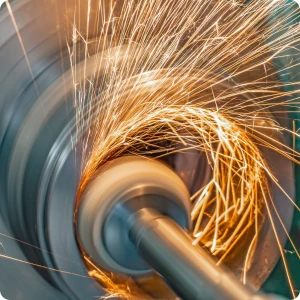
Cylindrical grinding is a machining process where both the cylindrical workpiece and the grinding tool rotate simultaneously. It is particularly well-suited for grinding the external surfaces of rotationally symmetric workpieces to obtain highly accurate dimensions. Furthermore, this process can even replace certain lathe operations and is effective for removing material from extremely hard workpieces.
Centerless grinding is a specialized precision grinding method that eliminates the need for mounting the workpiece on centers. Instead, the workpiece is positioned between a grinding wheel and a regulating wheel, with a workrest blade supporting it. This setup enables continuous grinding of parts, making it highly efficient for high-volume production runs.
Internal grinding resembles cylindrical grinding in that the workpiece is secured and processed between its center points. However, it stands apart from cylindrical grinding because only one end is clamped in the machine’s jaws. Internal grinding utilizes distinct motors to rotate both the grinding tool and the workpiece. Much like cylindrical grinding, the grinding wheel and workpiece operate in reverse rotations. The grinding wheel is moved in and out of the component to deliver precise measurements for inner bores.
Surface grinding is a grinding technique that uses a grinding wheel positioned either at a right angle (vertical spindle grinding) or in parallel alignment (horizontal spindle grinding) relative to the table. This method is ideal for flat workpieces. In vertical spindle grinding, a spinning grinding wheel trims material off flat, beveled surfaces, tapers, and slots. For horizontal spindle grinding, the workpiece is placed on a back-and-forth moving table or a rotary table and fed into a fixed, spinning grinding wheel.
Precision grinding offers several key advantages, which are outlined below:
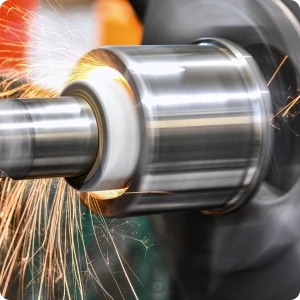
Precision grinding is an economical process, thanks to its capacity to deliver precise dimensions for high quantities of parts. Not only is the process swift, but it’s also flexible and highly dependable. It can be used on a broad range of materials (including hardened steel and non-ferrous metals) and rarely results in non-conforming components.
A high degree of accuracy is a major benefit of precision grinding. In manufacturing, processes like milling and turning are used to reach dimensions near the desired specifications. While these machining methods can often meet basic requirements, grinding lets manufacturers trim minute quantities of material to create exceptionally precise parts.
Precision grinding is a very dependable process. Flaws rarely arise during grinding, as the process is simple to configure, highly efficient, and exerts lower force on the workpiece compared to other methods (like machining) used to attain tight dimensional specs.
Tight tolerances are another perk of precision grinding. With this process, EPTAHUB is capable of reaching tolerances as narrow as +0.00025”. Such tight controls are ideal for parts used in the automotive, aerospace, and medical industries—especially in healthcare, where components are attached to or inserted into the human body, making precision non-negotiable.
Precision grinding yields exceptionally smooth surface finishes. This matters not only for operational performance (e.g., in medical tools like surgical instruments) but also for the visual appeal of the final product.
Precision grinding isn’t free of downsides. Its key disadvantages are outlined here:
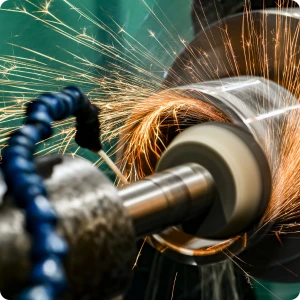
Precision grinding is time-intensive, which adds to overall costs. Fabricators and customers should determine together whether this process is truly needed, or if the tolerances from milling/turning will be adequate for the application.
Precision grinding equipment demands a significant upfront cost. Justifying this capital spend requires careful analysis of existing business cash flow and forecasts of higher business volume driven by the enhanced operational capacity of an on-site precision grinding machine.
For parts that need high levels of cleanliness (e.g., in medical, semiconductor, or food service industries), precision grinding may leave residual particles—either from the grinding wheel’s abrasive material or tiny material shavings from the part surface. These contaminants can undermine the part’s performance or cleanliness.

Multiple industries use precision grinding to create components featuring narrow dimensional tolerances and visually appealing finishes. Whether assembling parts in automotive systems or meeting surface finish specifications for surgical tools, precision grinding lets manufacturers consistently produce precise components. Common industries that rely on it include:

Methods like cylindrical grinding and surface grinding are commonly employed in the automotive industry to attain tight dimensional controls for parts in assemblies (e.g., gearbox/wheel bearings, crankshafts, gears, and axles).
AviationCylindrical grinding, centerless grinding, and creep feed grinding are three precision methods widely used in the aviation sector. They’re applied to secure accurate measurements for bearings, landing gear parts, engine components, and turbine parts (like blades, shrouds, and vanes).
BearingInternal grinding and cylindrical grinding are often used to reach strict dimensional tolerances for bearings. Exceptional accuracy is required to ensure the correct fit and operation of assemblies that use bearings. Bearings accommodate both linear and rotational movement (depending on the use case), and are found in motors, pumps, automotive gearbox/wheel bearings, skateboard wheels, jewelry, and watches.
ElectricalSurface grinding and cylindrical grinding are frequently utilized in the electrical industry for parts in electric motors, electronics, semiconductors, heat sinks, and more. Many electrical components need accurate sizing to fit in small, tightly packed assemblies and housings. Additionally, smooth surface finishes are often required for them to operate as designed.
MedicalPrecision grinding is widely applied in healthcare for parts like surgical tools, dental equipment, prosthetic parts, and implantable devices. Precision and high quality are critical for delivering optimal patient results and safety, as these components are often used inside the human body.
For some components, abrasive grinding might not be the best fit. EPTAHUB provides multiple alternatives to precision grinding, which are listed and explained here:
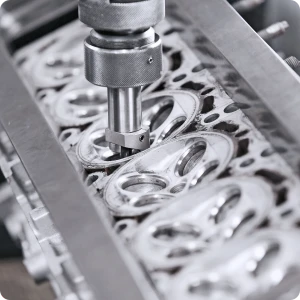
Reaming is a manufacturing process that employs a milling machine or drill press to widen pre-drilled holes/bores, refine their inner surfaces, and achieve accurate measurements. It can reach tolerances comparable to precision grinding (as narrow as +0.0002”), but is only suited for internal holes.
HoningHoning is a fabrication process analogous to reaming and grinding, using an abrasive stone/wheel to achieve precise tolerances. A honing machine presses a spinning abrasive stone against the part’s surface in a back-and-forth movement, creating a crisscrossed texture. It can reach tolerances as tight as +0.00025” and corrects issues like distortion, misalignment, and hole irregularities. While great for precise dimensions, it has a lengthier setup time and is costlier upfront due to equipment costs.
LappingLapping is a surface finishing technique that utilizes an abrasive slurry to trim small quantities of material and produce accurate sizing for workpieces. An abrasive powder blended with water or oil (to make a slurry) fills the space between two rubbing surfaces. The workpiece remains fixed while a “lap plate” moves back and forth against it. Lapping can achieve accuracy as fine as 0.00002” (or 0.5 micrometers), making it a top option for precise dimensions—but surface consistency isn’t always guaranteed.
Learn how to easily obtain an instant quote for Precision Grinding services through the EPTAHUB Instant Quoting Engine®.
Choose from millions of possible combinations of materials, finishes, tolerances, markings, and certifications for your order.

Quickly get instant quotes for precision grinding with our user-friendly quoting system.

We hold ISO 9001:2015, ISO 13485, and AS9100D certifications.
 English English
  German
 Spanish
 French
 Japanese
 Korean
 Malay
Malay
 Portuguese
 Russian
 Thai
Thai
Our automated quoting system gives you instant pricing so you can quickly estimate your project costs.
For high-precision or complex parts, our senior account managers can provide more detailed quotes and help you find the best overall solution for your needs.