High-Quality Industrial Metal 3D Printing DMLS And Binder Jetting Service
STEP丨STP丨SLDPRT丨STL丨IPT丨3MF丨3DXML丨PRT丨SAT
Metal 3D printing, an additive manufacturing technique, creates parts by
merging metal particles layer upon layer to form a metal component. It is
frequently selected as an alternative to CNC machining or metal casting
because it can produce parts that possess the strength and durability of
metal while also leveraging the design flexibility offered by 3D printing.
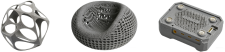
This method is capable of manufacturing complex designs, such as lattices
and topology-generated structures - both of which are impossible to create
through traditional CNC machining.
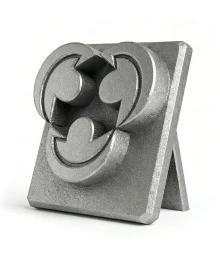
Metal 3D printing offers advantages as it can produce high-performance, complex metal parts suitable for a variety of end-use environments. Parts made via metal 3D printing are isotropic, meaning they have uniform, multi-directional strength, and they boast the excellent mechanical properties of metals like aluminum, stainless steel, titanium, Inconel, tool steel, and stainless steel-bronze composites.3D metal printing can also be utilized to integrate multiple assembly components into a single part. This usually leads to a stronger structure by reducing the potential failure points caused by threads and inserts.With metal 3D printing, CAD file data is sent directly to a printer, which typically makes parts more cost-effective and faster to produce than machined metal parts. Machined metal parts involve overhead costs such as tooling setup and longer machining time. Most 3D-printed metal parts can be completed in less than a week.
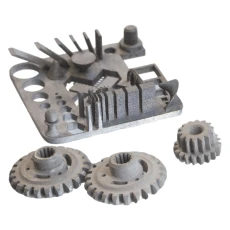
Upload your CAD files to receive an instant quote for metal prototypes and production parts.
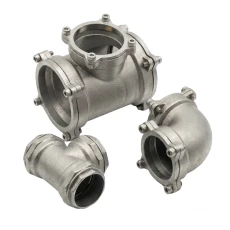
Upload your CAD files to get an instant quote on parts.
EPTAHUB's 3D metal printing services include direct metal laser sintering (DMLS) and metal binder jetting as available options. These processes are well-suited for creating metal prototypes, tooling, and production parts on demand. However, each metal 3D printing process utilizes different metals and fusion methods, resulting in parts with varying mechanical properties, price points, and lead times.
DMLS, also referred to as selective laser melting (SLM), uses a laser to selectively fuse sections of fine metallic powder from the bottom up. DMLS is advantageous because it can produce fully dense parts for fluid transfer applications. It can use materials such as aluminum AlSi10Mg, stainless steel, maraging steel, tool steel, cobalt chrome, and Inconel. While DMLS is more expensive than binder jetting, it offers superior mechanical properties for high-precision applications.
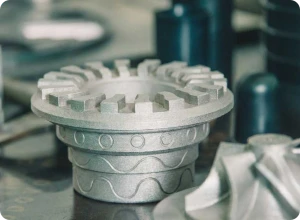
Metal binder jetting is a multi-step process that first selectively deposits a binding agent onto a metal powder bed, layer by layer, to hold the metal powder in a 3-dimensional form. This resulting shape is allowed to cure and is then placed in a furnace for sintering or infiltration with bronze. Binder jet parts that have overhanging features are supported by loose powder around the overhanging features, which usually eliminates the need for post-processing.
Binder jetting is a popular choice for metal 3D printing because parts are affordable and produced quickly, enabling higher-volume, cost-effective production. Binder jet metal parts are excellent for functional prototypes or end-use parts with a density of approximately 95% or higher. Metal binder jetting is also often used by artists and hobbyists due to its ability to create complex features at a fraction of the cost of DMLS or machining.
Unlike DMLS, binder jet parts are prone to shrinkage, so engineers should design parts while keeping Design for Manufacturing (DFM) principles in mind. This may involve scaling their CAD model size by 1–2% and enlarging holes.
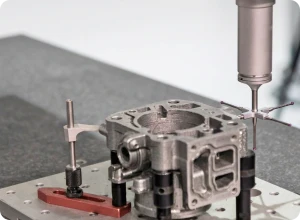
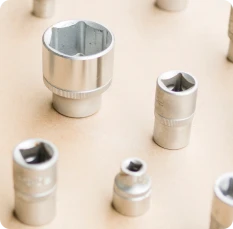
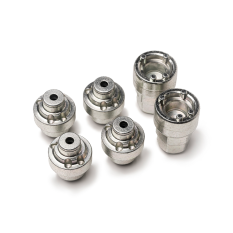
Metal 3D printing can be used for rapid industrial tooling, where 3D-printed metal parts can be employed for components with complex curvatures and small, thin-walled parts such as conformal jigs and fixtures, stamps, dies, and cutting inserts.
For other industries like consumer products, robotics, aerospace, and defense, metal 3D printing can be used to create integrated fastening features, end-effectors, and metal lattice structures. Since metal 3D-printed parts have exceptional durability and strength, they can be used in fully functional late-stage prototypes or end-use parts for any of the above applications.

Learn how to use the EPTAHUB (instant Quoting Engine @) Quickly and easily obtain Metal 3D Printing quotes.
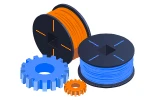
Select from millions of possible combinations of materials, finishes, tolerances, markings, and certifications for your order.

Have your parts delivered right to your door, without the hassle of sourcing, project management, logistics, or shipping.

We hold ISO 9001:2015, ISO 13485, and AS9100D certifications.
 English English
  German
 Spanish
 French
 Japanese
 Korean
 Malay
Malay
 Portuguese
 Russian
 Thai
Thai
Our automated quoting system gives you instant pricing so you can quickly estimate your project costs.
For high-precision or complex parts, our senior account managers can provide more detailed quotes and help you find the best overall solution for your needs.