Home / EPTAHUB’s Manufacturing Standards

EPTAHUB’s Manufacturing Standards

EPTAHUB has created an extensive collection of Design Guides to aid you in optimizing your design for the selected manufacturing method; please consult these resources for crucial tips and techniques

EPTAHUB's Fabrication Capabilities

All orders placed with EPTAHUB adhere to the minimum workmanship criteria detailed in the sections that follow (as relevant to your selected manufacturing process). If your project demands craftsmanship beyond these baseline standards, please clearly outline such requirements in your engineering drawings, purchase orders, or technical specifications.

Finished Surfaces Cosmetics

  • Paint application on all surfaces—including adjacent materials in assemblies—will be consistent and uniform.
  • Completed surfaces will be free from defects such as chips, scratches, or any form of damage.
  • Note: Sheet Cutting and Sheet Metal Fabrication services have distinct cosmetic guidelines, which are covered in their respective sections below.

Mill Steps, Tooling, And Chatter

  • As-milled surfaces will be free of burrs, chatter marks, tool gauge lines, and other flaws, while meeting specified surface roughness requirements.
  • Critical surfaces identified in drawings will be smooth across their entire area, with no visible mill steps or tool marks.
  • All milled surfaces will comply with stated surface roughness specifications.

Chips, Burrs, And Sharp Edges

  • Every exposed edge will be free from burrs, sharp protrusions, and metal slivers.*
  • *Exception: Sheet Cutting parts are not deburred unless this finish is explicitly selected during order placement.

Foreign Object Debris (FOD)

  • All surfaces will be clear of cutting fluids, metal shavings, foreign particles, and other contaminants.

Threads

  • Threads will be fully formed and machined to the exact size and class specified in provided drawings.
  • Threads will be free from defects, significant damage, and contamination.

Plated Surfaces

  • Plated finishes will be consistent across all surfaces, including adjacent areas in assemblies.
  • Plated surfaces will not have machining marks, scratches, pits, protrusions, or visible bare metal.
  • Minor imperfections may be acceptable in specific cases if they do not compromise the protective properties of the plating.

Weld Joints

  • Welds will be executed in strict accordance with customer-provided drawings.
  • Welds without specific requirements will be cleaned to remove slag and other surface contaminants.
  • Painting of weld joints will only occur after welding is complete and the weld has passed inspection.

Countersinks

  • Countersinks will be round, manufactured to drawing specifications, and enable proper fit with mating screws.
  • Countersinks will be free from burrs, chatter marks, and other tooling-related defects.

Painted Surfaces

  • Painted finishes will be consistent and continuous across the entire surface.
  • Painted surfaces will be free from visible machining marks, scratches, abrasions, dust particles, fisheyes, orange peel texture, or bare metal.
  • Painted surfaces should be evaluated against this standard at a distance of 18" with 1X magnification.

Supported Surfaces (Additive Manufacturing / 3D Printing)

  • Unless otherwise specified, EPTAHUB's additive manufacturing technicians (or EPTAHUB Partner technicians) will determine the optimal part orientation to balance design requirements, cost efficiency, and minimal support structure impact.
  • Processes requiring support structures may leave small residual marks where supports were attached.
  • Depending on the specific 3D printing process, these support vestiges can be reduced through secondary processes like sanding.
Industrial CNC milling and lathe turning for precision metal and plastic components

CNC Milling & Lathe Turning

  • For size features (length, width, height, diameter) and location features (position, concentricity, symmetry), tolerances are +/- .005" for metals and +/- .010" for plastics and composites, following ISO 2768 standards unless stated otherwise.
  • As-machined surface finish will be 125 Ra or better; machine tool marks may result in a swirl-like pattern.
  • Sharp edges are automatically broken and deburred. Critical edges that require a sharp finish must be clearly noted on the technical drawing.
  • Clear or transparent plastics will have a matte finish or translucent swirl marks on machined faces. Bead blasting will create a frosted appearance on clear plastics.
  • EPTAHUB cannot guarantee tolerances for foam or other compressible materials.
  • General tolerances for orientation and form features (including parallelism, perpendicularity, cylindricity, concentricity, flatness, circularity, and straightness) are outlined below, unless alternative tolerances are agreed upon in your quote.

CNC Orientation And Form General Tolerances for Metals

Table: Parallelism, Perpendicularity, Cylindricity, Circularity, Concentricity, Flatness, and Straightness over Part Length

Part Length Orientation and Form Tolerance (inch) Angularity Tolerance (degree)
0 to 12" .005" 0.5°
12" to 24" .010" 0.5°
24"- 36" 1/64"(.016")
36"- 60" 1/32"(.031")
Over 60" 1/16"(.063")

Form tolerances apply to metal machined components; for plastic and composite materials, tolerance values are typically double those specified for metals.

Discover More About CNC Machining

Custom online CNC machining solutions for prototypes and ISO-certified production parts

Custom Online CNC Machining Solutions

Real-time pricing estimates for custom metal & plastic machined components | Fast-turnaround prototypes and production parts within days | Tariffs included in international prototype pricing | Certified to ISO 9001:2015, ISO 13485, IATF 16949:2016, AS9100D standards; ITAR registered.

Custom Online CNC Machining Solutions

Precision metal die casting for high-quality durable aluminum and zinc components

Metal Die Casting

  • Standard mold machining tolerances are +/- .010", with an additional +/- .001" per inch to account for shrinkage.
  • Tighter as-molded tolerances can be requested but may increase tooling costs. Many tight tolerance requirements require mold manufacturing, sampling, and refinement. EPTAHUB will machine critical features to a steel-safe condition.
  • Critical toleranced features and surface finishes may require post-machining, which should be noted during the quoting phase prior to order placement. Post-machined features will adhere to EPTAHUB's CNC manufacturing standards.
  • EPTAHUB produces die cast components based on the net-shape (as-cast) model provided by the customer. These models must include sufficient material allowance for any required post-processing, such as machining. We recommend providing both the as-cast 3D model and the final model with accompanying technical drawings.
  • Part-to-part repeatability is typically within +/- .004".
  • As-cast surface finish is generally 64 µin. The standard finish for die casting is as-cast, and specific Ra values cannot be guaranteed without additional processing.
  • Lead time specified refers to the first article shipment (T1 shipment). Production time for remaining orders is confirmed after first article approval.
  • Typical first article shipments include five pieces, though this may vary based on part size, origin, and material.
  • All quotes assume designs include adequate draft angles, radii, and coring for optimal manufacturability.
  • Core design, side actions, and tooling strategy are determined by EPTAHUB unless explicitly discussed and agreed upon with the customer.
  • Gating, ejection points, knit lines, and parting lines are at EPTAHUB's discretion unless specified otherwise by the customer.
  • Die cast parts will have visible parting lines, appearing as thin ridges across the part.
  • Cast parts may have one or more gate vestiges, which are trimmed, sheared, or ground off during production.
  • Ejector pin marks—resembling small round flats—will be present on die cast parts.

Explore Die Casting Services

Top-tier custom die-casting solutions for manufacturing high-grade metal components

Custom Die Casting Solutions

Top-tier Die-Cast Metal Components.

Custom Die Casting Solutions

Plastic injection molding services for high-volume engineering-grade plastic components

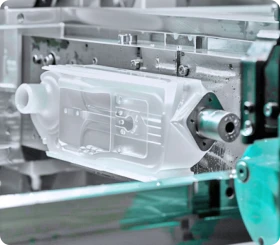
Injection Molding For Plastic Components

  • Standard mold machining tolerances are +/- .005", with an additional +/- .002" per inch to account for shrinkage.
  • Tighter tolerances can be requested but may result in higher tooling costs. Many tight tolerance requirements require mold manufacturing, sampling, and refinement. EPTAHUB will machine critical features to a steel-safe condition.
  • Part-to-part repeatability is typically within +/- .004".
  • Lead time specified refers to the first article shipment. Production time for remaining orders is confirmed after first article approval.
  • Typical first article shipments include 10 pieces, though this may vary based on part size, origin, and material.
  • EPTAHUB cannot guarantee an exact color match to Pantone standards.
  • All quotes assume designs include adequate draft angles, radii, and coring for optimal manufacturability.
  • Core design, side actions, and tooling strategy are determined by EPTAHUB unless explicitly discussed and agreed upon with the customer.
  • Gating, ejection points, knit lines, and parting lines are at EPTAHUB's discretion unless specified otherwise by the customer.

Learn More About Plastic Injection Molding

mo;ding280

Custom Plastic Injection Molding Solutions

Automated pricing quotes for custom plastic molded prototypes and production batches | Nearly unlimited material and finishing choices | Professional engineering evaluations and project management included with every order

Custom Plastic Injection Molding Solutions

Industrial metallic material extrusion process for complex aluminum and alloy profiles

Metallic Material Extrusion

  • All quotes assume designs include adequate wall thicknesses, radii, and feature sets optimized for the extrusion process.
  • Critical-to-function tolerances should be discussed during the quoting phase to ensure tooling strategy, check gages (if applicable), and other quality controls are included in the quote.
  • Linear cross-section dimensions have a tolerance of +/- .010" or +/- .006" per inch (whichever is greater), excluding wall thickness.
  • Wall thickness tolerance is +/- 10% of the specified dimension.
  • Cross-section angularity tolerance is +/- 1 degree for external corners and +/- 2 degrees for internal angles.
  • Critical toleranced features and surface finishes may require post-machining, which should be noted during the quoting phase prior to order placement. Post-machined features will adhere to EPTAHUB's CNC manufacturing standards.
  • Customer-provided models must include sufficient material allowance for any required post-processing, such as machining. EPTAHUB recommends providing both the extruded 3D model and the final model with accompanying technical drawings.
  • As-extruded surface roughness is 125 µin Ra.
  • Typical twist tolerance is not to exceed 0.5 degrees per 12" of length.
  • Straightness tolerance is not to exceed .0125" per 12" of length.
  • Sharp corners will have a minimum radius of .016".
  • Corner radii up to .188" have a standard tolerance of +/- .016". Radii exceeding .188" have a tolerance of +/- 10%.

Discover Metal Extrusion Services

Premium quality metal extrusion solutions for cost-effective industrial profile manufacturing

Metal Extrusion Solutions

Premium-Quality, Cost-Effective Metal Extrusions With EPTAHUB.

Metal Extrusion Solutions

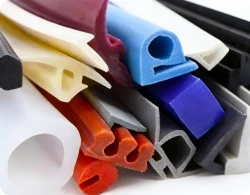
Plastic material extrusion profiles for custom engineering and industrial applications.

Plastic Material Extrusion

  • All quotes assume designs include adequate wall thicknesses, radii, and feature sets optimized for the extrusion process.
  • Critical-to-function tolerances should be discussed during the quoting phase to ensure tooling strategy, check gages (if applicable), and other quality controls are included in the quote.
  • Critical toleranced features and surface finishes may require post-machining, which should be noted during the quoting phase prior to order placement. Post-machined features will adhere to EPTAHUB's CNC manufacturing standards for plastics.
  • Customer-provided models must include sufficient material allowance for any required post-processing, such as machining. EPTAHUB recommends providing both the extruded 3D model and the final model with accompanying technical drawings.
  • Wall thickness tolerance is typically +/- 10% of the specified dimension.
  • Angularity tolerance is typically +/- 3 degrees for rigid materials and +/- 5 degrees for flexible materials.
  • Typical twist tolerance is not to exceed 0.5 degrees per 12" of length. Camber and bow tolerances are not to exceed .025" per 12" of length.
  • Plastic extrusion surface roughness will be 125 µin Ra or better.
  • Sharp corners will have a minimum radius of .016".
  • Extruded tubes are limited to four lumens unless otherwise agreed upon.
  • Internal dimensions of hollow features are difficult to control and require tolerances significantly larger than standard values.

Standard Plastic Extrusion Tolerances By Feature Size

Description Tolerance Notes
<.125" ± .010"
.125" - .500" ± .020"
.500" - 1.00" ± .030"
1.00" - 1.50" ± .035"
1.50" - 2.00" ± .040"
2.00" - 3.00" ± .045"
3.00" - 4.00" ± .065"
4.00" - 5.00" ± .085"
5.00" - 7.00" ± .100"
7.00" - 10.00" ± .125"

General tolerances depend heavily on the extruded material and cross-section complexity. Specialized tooling can be used to achieve tighter tolerances than those listed above.

Explore Plastic Extrusion Services

Custom plastic extrusion services for high-quality industrial profiles and components

Custom Plastic Extrusion Solutions

Premium-Quality, Budget-Friendly Custom Plastic Extrusions With EPTAHUB.

Custom Plastic Extrusion Solutions

Precision sheet material cutting services for various industrial raw stock materials

Sheet Material Cutting

  • Thickness tolerances are independent of cutting tolerances, as they depend on the raw material’s inherent tolerance range.
  • Edge-to-edge tolerance is +/- .010" nominal on the top face of the plate/sheet.
  • For thicker materials, the bottom face may have tolerance deviations due to tapers inherent in laser cutting or waterjet cutting processes.
  • EPTAHUB cannot guarantee flatness specifications for sheet cut materials unless the raw stock is ground stock or tooling plate (e.g., MIC6).
  • Holes with a diameter of .100" or smaller may be slightly larger on the top face than standard tolerances, as the cutter pierces the material near the hole’s cut line.
  • A small bump, divot, or distinct edge condition may be present at the lead-in and lead-out points of the cutting profile.
  • Pre-finished or textured sheets (e.g., brushed or polished stock) may only have the cosmetic finish on one side.
  • Protective film may be applied to cut products during shipment to prevent damage to cosmetic finishes.
  • Sheet cut materials will have vertical striations on edges (rather than smooth edges), which can affect the transparency of edges on clear plastics cut via waterjet.
  • Some cut materials may exhibit slight halo discoloration near cut edges due to waterjet backsplash or laser overspray.

Learn More About Sheet Cutting (Laser & Waterjet)

Precision laser and waterjet cutting services for custom flat metal components

Laser & Sheet Cutting Solutions

On-demand pricing quotes for laser-cut or waterjet-cut parts | No order minimums | Receive components within days | Tariffs included in international prototype pricing | Now featuring up to 35% lower costs and 30% faster lead times

Laser & Sheet Cutting Solutions

Professional sheet metal fabrication for custom industrial prototypes and production.

Sheet Metal Fabrication

  • Refer to Sheet Cutting standards for edge-to-edge and other cutting tolerances on flat surfaces.
  • Sharp edges are automatically broken and deburred. Critical edges that require a sharp finish must be clearly noted on the technical drawing.
  • Specific sheet metal designs—including hems, curled flanges, rolled sheets, stamped parts, and welded assemblies—require custom tooling and will be flagged for a manual quote. If your part includes these features, please allow our team to review and provide an accurate cost and lead time.

Learn More About Sheet Cutting (Laser & Waterjet)

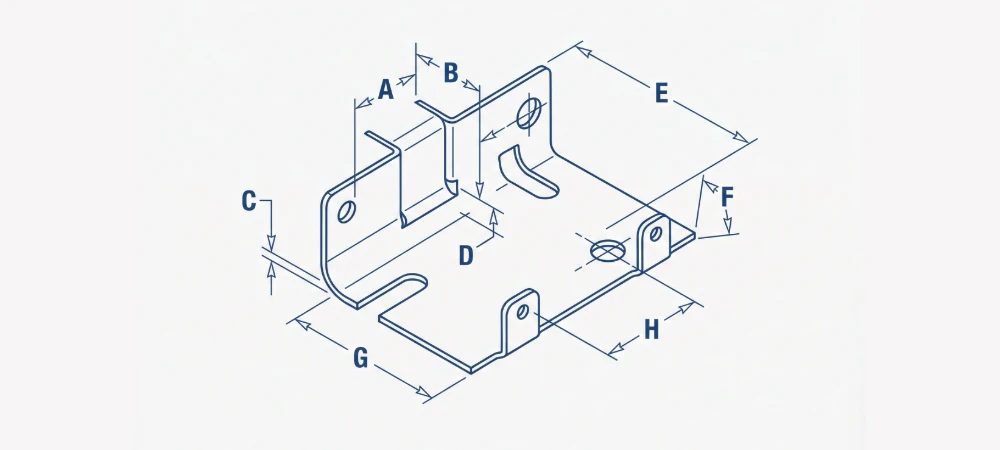
The following are EPTAHUB’s standard tolerances when no other tolerances are specified. Tighter tolerances are available with manual review if you provide a dimensioned drawing with explicit tolerance requirements.

Laser and waterjet sheet cutting services with precise industrial standard tolerances
A - ± .015″ (Edge to bend)
B - ± .030″ (Across bend)
C - Relies on the raw stock’s tolerances, based on material and thickness
D - ± .015″ (Bend to hole or internal cut feature)
E - ± .030″ (Overall edge-to-edge on formed part)
F - ± 1 Degree (Bend angle)
G - ± .030″ (Edge-to-feature over multiple formed surfaces)
H - ± .010″ (Feature edge-to-edge on the same surface, over the top of the cut face)

Explore Sheet Metal Fabrication

Custom sheet metal fabrication solutions featuring ISO-certified manufacturing standards

Sheet Metal Fabrication Solutions

Real-time pricing quotes for custom-shaped sheet metal parts | Prototype and production components within days | Tariffs included in international prototype pricing | Certified to ISO 9001:2015, ISO 13485, IATF 16949:2016, AS9100D standards; ITAR registered.

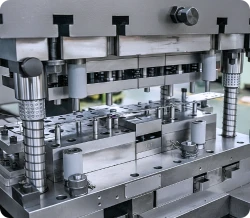
Sheet Metal Fabrication Solutions

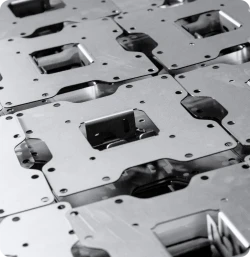
Precision metal stamping and forming for high-volume industrial hardware production.

Metal Stamping Forming

  • All quotes assume designs include adequate draft angles, radii, relief cuts, and feature sets optimized for the stamping process.
  • Critical-to-function tolerances should be discussed during the quoting phase to ensure tooling strategy, check gages (if applicable), and other quality controls are included in the quote.
  • Raw materials such as coiled strip are not inherently flat, and this characteristic may be visible on flat stamped or coined components.
  • Dimensions apply to the inside of formed features.
  • Typical angular tolerance is +/- 1 degree.
  • Stamped parts will be free from splits and other forming defects.
  • Punch and die-cut features (e.g., edges) will have straight walls with a small burr (approximately ¼ to ⅓ down the wall thickness) on the bottom edge.
  • Large burrs and tabs will be removed, but parts are not fully manually deburred prior to shipment when the standard as-cut finish is selected.
  • Linear dimensions for internal holes are measured at the shear (smallest portion of the cut feature).
  • Tooling marks are a normal byproduct of the metal forming process. These marks can be minimized through secondary processing or adjusted tooling strategy. It is important to identify cosmetic features to EPTAHUB during the quoting or project kickoff phase.
  • Material thickness may vary across formed and drawn features.
  • Part-to-part repeatability is typically within +/- .004” (+/- .002” typical).

Discover Metal Stamping Services

Metal stamping solutions for small-batch runs and large-scale manufacturing projects

Metal Stamping Solutions

High-Grade Metal Stamped Parts — From Small-Batch Runs to Large-Scale Production of Millions of Units.

Metal Stamping Solutions

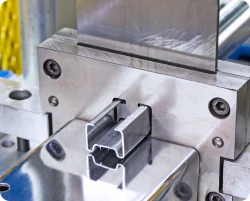
Advanced laser-based tube cutting for round, square, and rectangular metal profiles

Laser-Based Tube Cutting

  • Cut edges are normal-to-surface by default. Normal-to-edge cuts require explicit agreement during order placement.
  • Thickness tolerances are independent of cutting tolerances, as they depend on the raw stock’s inherent tolerance range.
  • Edge-to-edge tolerance for laser cut features is +/- .010” nominal on the inner face of the tube.
  • Holes with a diameter of .100” or smaller may be slightly larger than standard tolerances, as material piercing occurs near the hole’s profile. Holes requiring drilling or machining precision will undergo manual review during quoting.
  • A small bump of material or distinct edge condition may be present at the lead-in and lead-out points of the cutting profile.
  • Large burrs and tabs will be removed, but parts are not fully manually deburred prior to shipment when the standard as-cut finish is selected.
  • Some cut materials may exhibit slight halo discoloration near or across from cut edges due to backsplash or overspray.

Learn More About Laser Tube Cutting

Top-quality laser tube cutting solutions for precision metal framing and components

Laser Tube Cutting Solutions

Top-quality laser cutting for rectangular, square, and round metal tubes | Tariffs included in international prototype pricing

Laser Tube Cutting Solutions

Comprehensive general manufacturing services for custom parts and industrial assembly

Comprehensive General Manufacturing

  • EPTAHUB is not responsible for the fit of mating parts.
  • EPTAHUB is not responsible for the functionality of snap tabs, clips, or living hinges.
×

EPTAHUB Professional & Intelligent Quoting

Our automated quoting system gives you instant pricing so you can quickly estimate your project costs.

For high-precision or complex parts, our senior account managers can provide more detailed quotes and help you find the best overall solution for your needs.

Get Instant Quote Get a Quote Instantly — ⭐⭐⭐
Request Expert Quote Precise Quotes — ⭐⭐⭐⭐⭐