










Hello, this is your senior engineer from Eptahub. Let’s tackle one of the most persistent and confusing questions I encounter in the world of metal fabrication: What is the real difference between 18/8, 304, and 316 stainless steel?
I’ve seen purchase orders delayed, products fail prematurely, and budgets wasted, all because of a misunderstanding of these three terms. You might see a water bottle marketed as “18/8,” a kitchen sink specified as “Type 304,” and a boat cleat sold as “Marine Grade 316.” Are they all the same? Are they interchangeable? The short answer is a definitive no.
The confusion arises because you are looking at two different naming conventions: one is a commercial nickname, and the other two are formal engineering grades.
Decoding the Names: The Most Important “Aha!” Moment
Let’s start by clearing up the biggest misconception. “18/8” is not a formal grade of steel.
“18/8” is a nickname or marketing term that refers to the approximate chemical composition of the steel.
- 18 refers to ~18% Chromium content.
- 8 refers to ~8% Nickel content.
Type 304 Stainless Steel is the formal, internationally recognized grade designation (from standards bodies like SAE and ASTM) for a steel whose composition is, you guessed it, approximately 18% chromium and 8% nickel.
Therefore, for all practical engineering and purchasing purposes:
18/8 Stainless Steel is Grade 304 Stainless Steel.
When a consumer product is marketed as “18/8,” they are using a user-friendly name to describe what an engineer calls 304. When you write a specification for a part, you should always use “Type 304” to be precise and unambiguous.
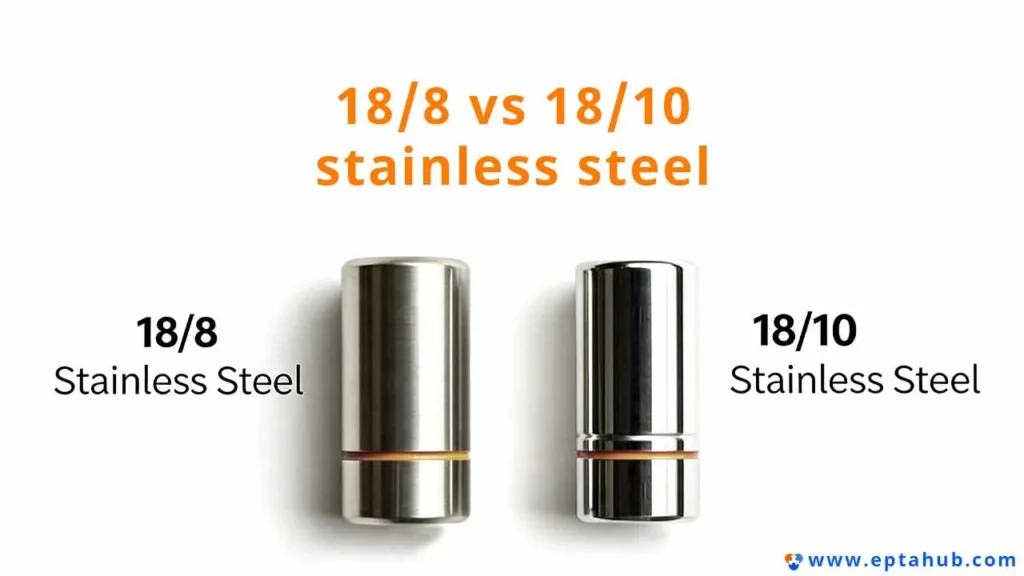
What about 18/10?
You will also see “18/10” stainless steel, especially for high-end cookware and flatware. This is another nickname, indicating ~18% Chromium and ~10% Nickel. This is also a sub-type of Grade 304. The slightly higher nickel content can give it a marginally better surface luster and slightly enhanced formability, but it is still fundamentally a 304-type steel and does not have the enhanced corrosion resistance of 316.
What’s Inside Matters?
Now that we’ve established that 18/8 is essentially 304, we can focus on the real engineering decision: 304 vs. 316. To understand their performance differences, we must look at their recipes. The difference is subtle on paper but has massive real-world consequences.
Table 1: Nominal Chemical Composition of 304 vs. 316 (Weight %)
| Element | Symbol | Type 304 (aka 18/8) | Type 316 | Engineering Significance of the Element |
|---|---|---|---|---|
| Iron | Fe | Balance | Balance | The primary base metal of the alloy. |
| Chromium (Cr) | Cr | 18.0 – 20.0% | 16.0 – 18.0% | The “Stainless” element. Forms the critical, invisible chromium-oxide passive layer that prevents rust. |
| Nickel (Ni) | Ni | 8.0 – 10.5% | 10.0 – 14.0% | Stabilizes the non-magnetic austenitic structure, boosts general corrosion resistance, and improves formability. |
| Molybdenum (Mo) | Mo | None | 2.0 – 3.0% | THE GAME-CHANGING DIFFERENCE. Provides a massive boost in resistance to localized chloride corrosion. |
| Carbon (C), Max | C | 0.08% | 0.08% | Kept low to prevent corrosion after welding. “L” grades (304L/316L) have even less (0.03% max). |
| Manganese (Mn), Max | Mn | 2.0% | 2.0% | Improves strength and hot-working characteristics during manufacturing. |
The most important line in that table is Molybdenum (Mo).
- 304 (18/8) has no intentionally added Molybdenum.
- 316 has 2-3% Molybdenum intentionally added.
This is it. This is the entire reason for 316’s existence, its higher price, and its superior performance in specific environments. Molybdenum is the special ingredient that elevates 316 to a higher tier of corrosion resistance.
Performance Deep Dive I: The War Against Corrosion
This is where the chemical difference becomes a physical reality. Molybdenum is a powerful weapon in the fight against corrosion, specifically against chlorides.
Chlorides are common and highly aggressive corrosive agents found in:
- Salt water (oceans, estuaries)
- De-icing salts on roads and highways
- Industrial chemicals and many cleaning solutions (including bleach)
- High-sodium food products (brines, soy sauce)
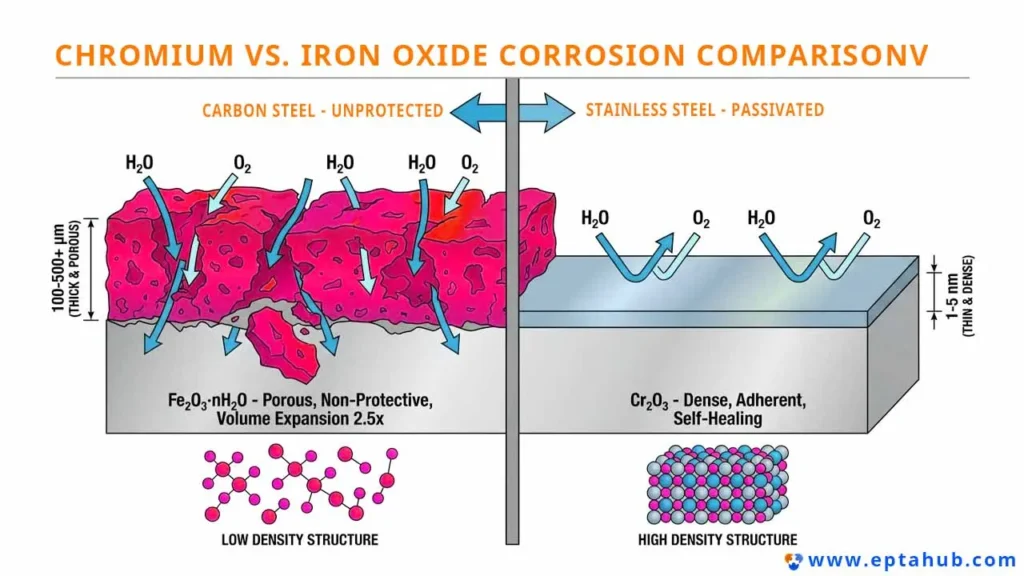
The standard chromium-oxide passive layer on 304 (18/8) stainless steel provides excellent protection against general rusting in most atmospheric and freshwater conditions. However, when chlorides are present, this layer is vulnerable to two devastating forms of localized attack:
- Pitting Corrosion: This is a localized attack where chlorides breach the passive layer in tiny spots, creating deep, narrow “pits.” The rest of the surface can look completely fine, but these pits can penetrate through the metal, causing leaks and sudden, unexpected failures. It’s the stainless steel equivalent of a cavity in a tooth.
- Crevice Corrosion: This occurs in tight, oxygen-starved gaps, like under a fastener head or between two overlapping plates. Chlorides can concentrate in these crevices, creating a highly aggressive micro-environment that rapidly corrodes the metal.
This is where Molybdenum earns its premium price. The 2-3% Mo content in 316 stainless steel fundamentally enhances the stability and resilience of the passive layer. It makes it much more difficult for chlorides to initiate pitting and allows the layer to “re-passivate” or heal itself more effectively if it does get damaged.
An Analogy for Engineers:
- 304 (18/8) is like a standard, high-quality industrial coating. It protects against general wear and tear perfectly.
- 316 is like a specialized, chemical-resistant epoxy coating. It’s specifically formulated to withstand attack from a known, aggressive chemical (in this case, chlorides).
Performance Deep Dive II: The Strength & Mechanical Properties Myth
It’s a common assumption that because 316 is more expensive and “better” at corrosion resistance, it must also be stronger. This is a critical and costly misconception.
Let’s look at the typical mechanical properties.
Table 2: Typical Mechanical Properties of 304 vs. 316 at Room Temperature
| Property | Type 304 (18/8) | Type 316 | Conclusion for Sourcing |
|---|---|---|---|
| Tensile Strength, Ultimate | 515 MPa (75,000 psi) | 515 MPa (75,000 psi) | Identical. Switching from 304 to 316 provides no gain in ultimate strength. |
| Yield Strength (0.2% Offset) | 205 MPa (30,000 psi) | 205 MPa (30,000 psi) | Identical. Both will begin to permanently deform at the same stress level. This is not a deciding factor. |
| Hardness (Rockwell B) | 92 | 95 | Negligible difference. Both are considered relatively soft austenitic steels. |
| Elongation at Break | 40% | 40% | Identical. Both are exceptionally ductile, meaning they can be stretched, bent, and formed easily without fracture. |
The data is unequivocal. You do not choose 316 over 304 for mechanical strength. Their properties are so similar that they are considered interchangeable in any design calculation based on strength. If your 304 stainless steel part is failing because it isn’t strong enough, upgrading to 316 will not solve your problem. You would need to look at a different class of steel entirely (like a Duplex or a Precipitation Hardening grade) or increase the part’s thickness.
The decision to specify 316 is a decision about surviving a corrosive environment, and nothing more.
The Economic Reality: The Cost of Molybdenum
The first and most tangible difference a buyer will notice is the price.
Grade 316 is always significantly more expensive than Grade 304 (18/8).
Depending on market fluctuations, you can expect to pay a 25% to 40% cost premium for 316 over 304 for the same product form (e.g., a sheet of the same thickness or a bar of the same diameter).
This price difference is directly attributable to the alloying elements:
- Molybdenum (Mo): This is a relatively expensive refractory metal. Adding 2-3% of it to the steel recipe is the single largest contributor to the price increase.
- Nickel (Ni): 316 also requires a slightly higher percentage of nickel (a minimum of 10% vs. 8% for 304). Nickel is a volatile and expensive commodity, further adding to the cost of 316.
This cost premium is the central axis around which your decision must rotate. You must weigh the upfront investment in 316 against the long-term risk of failure with 304. This is a classic lifecycle cost analysis.
Application : A Verdict for Common Scenarios
Let’s put our knowledge to the test in practical applications.
Verdict: Use 304 (18/8) Stainless Steel When:
- Application: Kitchen Sinks, Cookware, and Flatware
- Environment: Exposure to water, food acids, and detergents. Chlorides from food or water are not highly concentrated and are washed away.
- Reasoning: 304 provides more than enough corrosion resistance for this environment. It is hygienic, durable, and cost-effective. This is the global standard for consumer kitchen goods. “18/10” is often used for high-end flatware for a slightly brighter luster, but it’s still a 304 type.
- Application: Food & Beverage Processing (for benign products)
- Environment: Tanks, pipes, and surfaces for dairy, beer, wine, and processed foods that are not highly acidic or saline.
- Reasoning: 304’s resistance to organic acids and its cleanability make it the perfect workhorse. It is a false economy to use 316 here.
- Application: Architectural Trim and Panels (in non-coastal areas)
- Environment: Building facades, interior decoration, and railings in cities and rural areas away from the coast.
- Reasoning: 304 offers excellent resistance to atmospheric corrosion from rain and pollution. There is no chloride threat from salt spray, so 316 is unnecessary over-engineering.
- Application: General-Purpose Hardware and Fasteners (for indoor or mild outdoor use)
- Environment: Nuts, bolts, brackets, and screws used inside or in areas not subject to salt or heavy industrial pollutants.
- Reasoning: Cost-effective and provides a “stainless” appearance with good general corrosion resistance.
Verdict: You MUST Upgrade to 316 Stainless Steel When:
- Application: All Marine Hardware
- Environment: Constant exposure to salt water, salt spray, and marine fog.
- Reasoning: This is the quintessential application for 316. The high chloride concentration in seawater will cause 304 (18/8) to pit and rust in a surprisingly short amount of time. Railings, cleats, fasteners, anchors—anything on a boat—demands 316. It is often called “Marine Grade” for this reason.
- Application: Coastal and Roadside Architecture
- Environment: Buildings near the ocean or major highways in cold climates where de-icing salts are used.
- Reasoning: Salt spray from the ocean or kicked up from salted roads will deposit chlorides on building surfaces. 316 is mandatory to prevent unsightly rust staining and structural pitting.
- Application: Pharmaceutical and Chemical Processing
- Environment: Vats, pipes, and reactors that handle a wide variety of chemicals, many of which contain chlorides. Equipment must also withstand aggressive cleaning and sterilization cycles.
- Reasoning: 316L (the low-carbon version) is the default standard in the pharmaceutical industry due to its superior chemical resistance and weldability, ensuring product purity and equipment longevity.
- Application: Food Processing (with saline products)
- Environment: Equipment used to make brines, cure meats, process pickles, or manufacture sauces with high salt content.
- Reasoning: The constant exposure to high concentrations of sodium chloride will cause 304 to fail. 316 is required to prevent pitting and metallic contamination of the food product.
The Disadvantages of 316 Stainless Steel: An Honest Assessment
While 316 is a superior material in certain contexts, it’s not without its drawbacks. A good engineer knows the limitations of every material.
- The Primary Disadvantage: COST. This cannot be overstated. Its higher price is its single biggest disadvantage. Specifying it when it’s not needed is a waste of resources that could be better allocated elsewhere in a project.
- Not a Strength Upgrade: A significant disadvantage is the misconception that it’s stronger. An engineer might specify 316 to solve a mechanical failure problem, only to find the new part fails in the same way. This wastes time and money by misdiagnosing the root cause of a problem.
- Slightly Reduced Machinability: While not a dramatic difference, some machinists find that 316 can be slightly “gummier” and more difficult to machine than 304, potentially leading to slightly higher machining costs or slower cycle times.
- Not Universally “Better”: While superior against chlorides, 316 is not necessarily better against all chemicals. For example, in some highly oxidizing acid environments, certain specialized grades of stainless steel might outperform 316. It is a specialist, not a panacea.
How to Specify Stainless Steel with Zero Ambiguity?
On your engineering drawings and RFQs, precision is paramount. Use this protocol to eliminate confusion.
- Use Formal SAE/ASTM Grade Designations. Never use nicknames.
- Avoid: “18/8 Stainless” or “Marine Grade Stainless”
- Specify: “Stainless Steel, Type 304” or “Stainless Steel, Type 316”
- Specify “L” Grade for All Welded Components. This is a critical best practice to prevent post-weld corrosion.
- Example: “Material: Stainless Steel, Type 316L, per ASTM A240”
- Reference the Material Standard for the Product Form. This tells the supplier the exact specification the material must meet.
- Sheet/Plate: ASTM A240
- Bar/Rod: ASTM A276
- Pipe: ASTM A312
- Forgings: ASTM A473
- Demand Certified Material Test Reports (MTRs). This is non-negotiable for professional sourcing. An MTR is the “birth certificate” from the steel mill, providing the exact chemical analysis of the material lot you are receiving. It is your ultimate proof that you received 316 when you paid for it.
- PO Note: “Certified MTRs traceable to heat lot required with shipment.”
FAQs
Q: Which is better, 18/8 or 18/10 stainless steel?
A: Both are types of Grade 304. “18/10” simply has a slightly higher nickel content (10% vs. 8%). This can give it a slightly brighter shine and marginally better deep-drawing performance. For corrosion resistance and strength, they are practically identical. Neither is a substitute for 316.
Q: Is 18/8 stainless steel magnetic?
A: In its fully annealed (softened) state, 18/8 (304) is non-magnetic. However, when it is cold-worked (bent, stamped, or drawn), its microstructure can change, inducing a small amount of magnetism.
Q: What is the main difference between 18/8 vs. 316?
A: The main difference is that 316 contains 2-3% molybdenum, while 18/8 (304) does not. This gives 316 vastly superior corrosion resistance in environments containing salt or other chlorides.
Conclusion: From Nickname to Informed Decision
The world of stainless steel is filled with numbers and jargon, but the choice between 18/8, 304, and 316 doesn’t have to be confusing. The solution is to think like an engineer:
First, translate the nickname: 18/8 is 304.
Second, identify the key difference: 316 has Molybdenum.
Third, ask the critical question: “Is my part exposed to chlorides (salt)?”
If the answer is no, your cost-effective, reliable choice is 304. If the answer is yes, the added investment in 316 is not just a good idea—it’s a professional necessity.
By following this clear logic and using precise specifications, you move beyond marketing terms and into the realm of professional procurement. You ensure that every dollar is spent wisely and every component is built to last in its intended environment. At Eptahub, this is the standard of clarity we demand for every project.
References
- ASTM International, “ASTM A240 / A240M, Standard Specification for Chromium and Chromium-Nickel Stainless Steel Plate, Sheet, and Strip for Pressure Vessels and for General Applications. https://www.astm.org/a0240_a0240m-20.html
- ASTM International, “ASTM A276 / A276M, Standard Specification for Stainless Steel Bars and Shapes”. https://www.astm.org/a0276_a0276m-17.html