









Home / Design Guides / An Overview of Injection Molded Surface Finishes

An Overview of Injection Molded Surface Finishes

Professional headshot of James Miller, EPTAHUB manufacturing expert and technical author.

Written by

James Miller
About 4 minutes
Injection molded plastic parts showcasing SPI, Mold-Tech, and VDI EDM surface finishes from glossy to matte

Table of Contents

A frequently asked question at EPTAHUB is, "What do your molded parts look like?" The answer is: whatever you want! EPTAHUB has access to a diverse network of molding suppliers and all standard mold finishing options. EPTAHUB's mold finishes include SPI, Mold-Tech, VDI (EDM), and others. Mold finishes can range from glossy to matte and even patterned. The finish applied to the surface of the mold cavity is transferred to the surface of the molded part. For example, a mold surface polished to be reflective will produce a reflective (or transparent) part. Mold finishes differ from those used for CNC machined or 3D printed parts, where each component is treated individually. Adding a finish or texture can change the tooling cost based on the required process, but it does not affect the unit cost of individual parts.

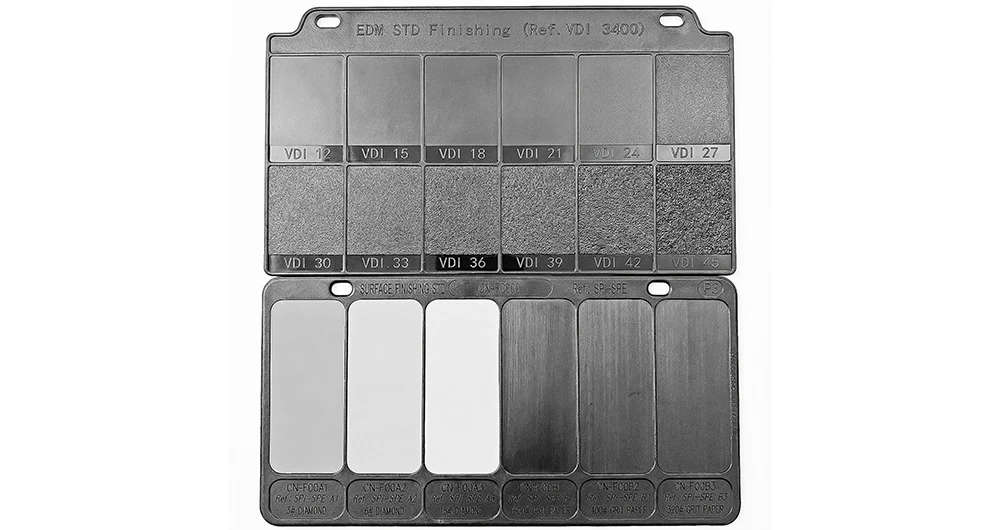
The most commonly used finishes include those defined by the Society of the Plastics Industry (SPI). These are a set of standard mold finishes ranging from highly polished (SPI A) to semi-gloss (SPI B), and extending to fine and coarse matte (SPI C and SPI D). While polished finishes can enhance the cosmetic reflectivity or transparency of transparent polymers, matte finishes help create more understated tones and even prevent fingerprints on frequently handled products (e.g., your laptop's frame and keyboard).
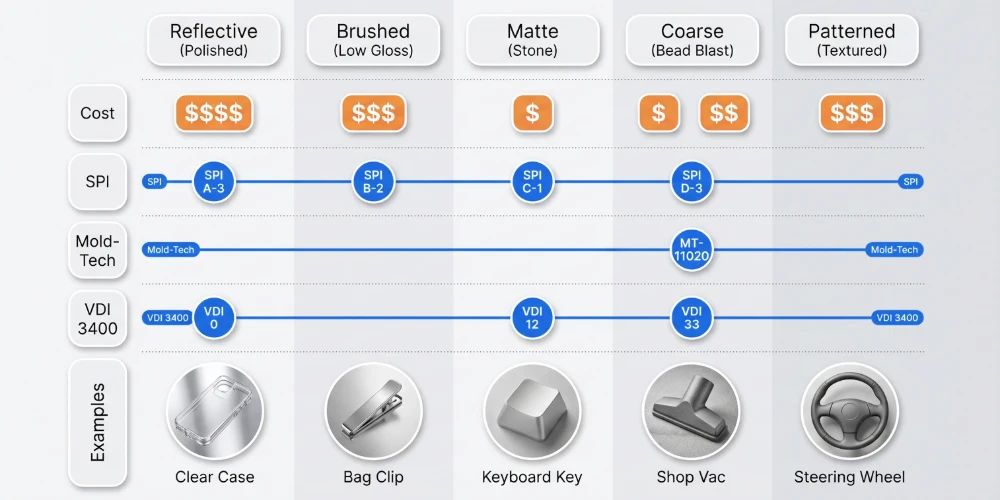
Comparison of SPI A polished and SPI B semi-gloss finishes on plastic injection molded plaques.

Get Your Free EPTAHUB Guide to Injection Molding Finishes

Society Of The Plastics Industry (SPI) Mold Finishes

Standard SPI Injection Molding Finishes

SPI Finish Description Typical Applications Surface Roughness (Ra µm)
SPI A-1 Grade #3, 6000 Grit Diamond Buff High polish or transparent parts, optically clear 0.012 - 0.025
SPI A-2 Grade #6, 3000 Grit Diamond Buff High polish or transparent parts 0.025 - 0.050
SPI A-3 Grade #15, 1200 Grit Diamond Buff High-to-medium polish parts, non-optical lenses 0.050 - 0.100
SPI B-1 600 Grit Paper Medium polish parts 0.05 - 0.10
SPI B-2 400 Grit Paper Medium polish parts 0.10 - 0.15
SPI B-3 320 Grit Paper Medium-low polish parts 0.28 - 0.32
SPI C-1 600 Stone Low polish parts 0.35 - 0.40
SPI C-2 400 Stone Low polish parts 0.45 - 0.55
SPI C-3 320 Stone Low polish parts 0.69 - 0.70
SPI D-1 Dry Blast Glass Bead Satin finish 0.80 - 1.00
SPI D-2 Dry Blast #240 Oxide Dull finish 1.00 - 2.80
SPI D-3 Dry Blast #24 Oxide Dull finish 3.20 - 18.00

Mold-Tech Textured Finishes

Standex Engraving Mold-Tech is a standardized mold texturing solution commonly used for commercial or marketable products. Mold-Tech is categorized into four series, A to D. Most often, Mold-Tech Series A finishes are applied to products, as they offer a range of fine to coarse matte finishes that do not require laser treatment, masked chemical etching, or other engineered texturing processes. Mold-Tech finishes are classified by their serial number and texture depth. A steeper draft angle is required for Mold-Tech finishes: since its mold texturing has coarser features than SPI finishes, it is recommended to add 1.5° of draft for every 0.001" of texture depth.

EPTAHUB brand icon - return to homepage and explore professional manufacturing services

Ready to your Injection Molding quote?
Mold-Tech A Finishes

Common Mold-Tech Injection Molding Finishes

Mold-Tech Serial Number Texture Depth (inch) Application Minimum Draft
MT-11010 0.001" Dull matte finish 1.5°
MT-11020 0.0015" Coarse matte finish 2.25°
MT-11030 0.002" Coarse matte finish

VDI 3400 Surface Finish

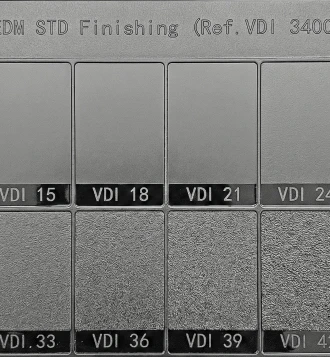
VDI 3400 Surface Finish (commonly referred to as VDI surface finish) is a mold texturing standard established by Verein Deutscher Ingenieure (VDI), the Association of German Engineers. During mold machining, the VDI 3400 surface finish is mainly achieved through Electrical Discharge Machining (EDM). VDI is an international standard for matte molded parts. The surface can have a fine-to-coarse grain, depending on the specific requirements. VDI is different from Mold-Tech—Mold-Tech textures are applied through various techniques, from manual finishing and laser etching to patterned chemical etching. However, some textures may have near equivalents; for example, SPI D-3, VDI 33, and MT-11020 all have a very similar appearance. Similarly, VDI 12 is equivalent to SPI C-1.

Mold texturing samples showing VDI 3400 matte finishes achieved through Electrical Discharge Machining.

VDI (EDM) Mold Texture Values

Common VDI Injection Molding Finishes

VDI Value Description Applications Surface Roughness (Ra µm)
VDI 12 600 Stone Low polish parts 0.40
VDI 15 400 Stone Low polish parts 0.56
VDI 18 Dry Blast Glass Bead Satin finish 0.80
VDI 21 Dry Blast #240 Oxide Dull finish 1.12
VDI 24 Dry Blast #240 Oxide Dull finish 1.60
VDI 27 Dry Blast #240 Oxide Dull finish 2.24
VDI 30 Dry Blast #24 Oxide Dull finish 3.15
VDI 33 Dry Blast #24 Oxide Dull finish 4.50
VDI 36 Dry Blast #24 Oxide Dull finish 6.30
VDI 39 Dry Blast #24 Oxide Dull finish 9.00
VDI 42 Dry Blast #24 Oxide Dull finish 12.50
VDI 45 Dry Blast #24 Oxide Dull finish 18.00

Unless otherwise specified, an injection molded part typically has an SPI B-2 default finish. This finish facilitates better part release from the mold and eliminates tool marks. Surface finishes can be applied to some or all surfaces of the part; for example, an opaque molded part can have a custom outer surface finish, while its inner, non-cosmetic surface can retain the default finish. If required, multiple finishes and textures can be applied to a single mold cavity. Transparent parts are usually polished on both sides to achieve the highest clarity.

EPTAHUB offers a wide variety of surface finishes and additional mold textures to ensure that your parts meet all their structural and cosmetic requirements. Learn more about EPTAHUB's injection molding services.

Professional headshot of James Miller, EPTAHUB manufacturing expert and technical author.

James Miller

As the Director of Application Engineering at EPTAHUB, I lead our design-for-manufacturing initiatives and consult on a wide range of custom projects. My expertise spans CNC machining, additive manufacturing, sheet metal, urethane casting, and injection molding. I'm here to answer your questions.
EPTAHUB official logo - leading on-demand manufacturing and supply chain solutions provider
Ready to Manufacture?

Get instant pricing & DFM feedback

75,000+

Number Of Buyers

4,500+

Number Of Suppliers

150M+

Number Of Parts Shipped

4.8/5

Trustpilot Star Rating

Ready for Your Project?

Professional headshot of James Miller, EPTAHUB manufacturing expert and technical author.

Written By
James Miller

James Miller is a Senior Manufacturing Engineer and technical writer with over a decade of experience in CNC machining, precision injection molding, and advanced rapid prototyping. Having bridged the gap between complex design engineering and factory-floor execution, he specializes in translating high-end manufacturing standards into practical, actionable insights for Eptahub’s clients. He is passionate about Design for Manufacturability (DFM) and helping engineers optimize their parts. When he’s not writing, James Miller enjoys woodworking and exploring the great outdoors with his family.

Recent Blog Posts

×

EPTAHUB Professional & Intelligent Quoting

Our automated quoting system gives you instant pricing so you can quickly estimate your project costs.

For high-precision or complex parts, our senior account managers can provide more detailed quotes and help you find the best overall solution for your needs.

Get Instant Quote Get a Quote Instantly — ⭐⭐⭐
Request Expert Quote Precise Quotes — ⭐⭐⭐⭐⭐