











When I sit in a design review meeting at EPTAHUB and look at a new client’s CAD model for a load-bearing bracket, the first thing I look for isn’t the aesthetic design. I am looking for the failure points. I am looking at how much that bracket is going to stretch, bend, or twist before it snaps.
In everyday conversation, the word “strain” usually refers to muscle pain or mental stress. But when you look up the strain definition engineering, it is a highly specific, mathematical concept. It is arguably one of the most important concepts in all of mechanical engineering and materials science.
If you are a product designer, a procurement manager evaluating material data sheets, or a junior engineer trying to understand why a prototype failed, you cannot just look at the raw strength of a material. You have to understand how that material changes shape under a load.
In this guide, I will clearly define the strain meaning, break down the different types of strain in physics and engineering, and show you exactly how we use the strain formula to predict whether a part will survive or fail in the real world.
What is Strain?
To understand strain, we first have to briefly mention its partner: Stress.
Stress is the physical force pushing or pulling on an object (measured in pressure, like PSI or Pascals).
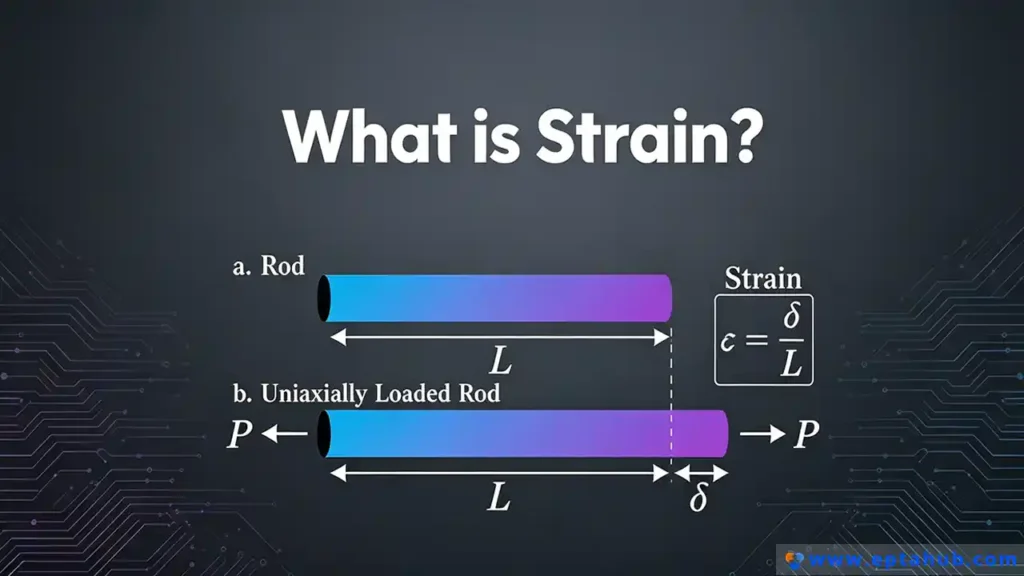
If stress is the action, strain is the reaction.
Strain is the mathematical measurement of how much an object physically deforms (changes shape or size) as a result of the stress being applied to it.
If you hang a heavy weight from a rubber band, the weight is applying stress. The rubber band stretching and getting longer is the strain.
The Crucial Detail: Strain Units
People often search for strain units, expecting to find something like millimeters, inches, or pounds.
Here is the trick: Strain is a dimensionless unit. It has no unit of measurement.
Why? Because strain is a ratio. It is a percentage of change.
If you have a 10-inch steel rod, and you pull on it until it stretches to 11 inches, the change in length is 1 inch. The strain is the change in length (1 inch) divided by the original length (10 inches).
1 inch / 10 inches = 0.10.
The inches cancel each other out. The strain is simply 0.10 (or 10%).
Source Validation: The dimensionless nature of strain is a foundational principle of solid mechanics, universally taught in engineering textbooks such as Shigley’s Mechanical Engineering Design and standardized by organizations like ASTM International during tensile testing (e.g., ASTM E8 for metallic materials).
The Big 4: Types of Strain
When someone asks, “What are the 4 types of strain?”, they are asking about the different ways a physical object can be distorted by outside forces.
At EPTAHUB, depending on whether we are CNC machining a titanium aerospace hinge or injection molding a flexible TPU gasket, we have to calculate for different types of deformation.
1. Tensile Strain (Pulling Apart)
This is the most common and easiest type of strain to visualize. Tensile strain occurs when an object is pulled from opposite ends, causing it to stretch and elongate.
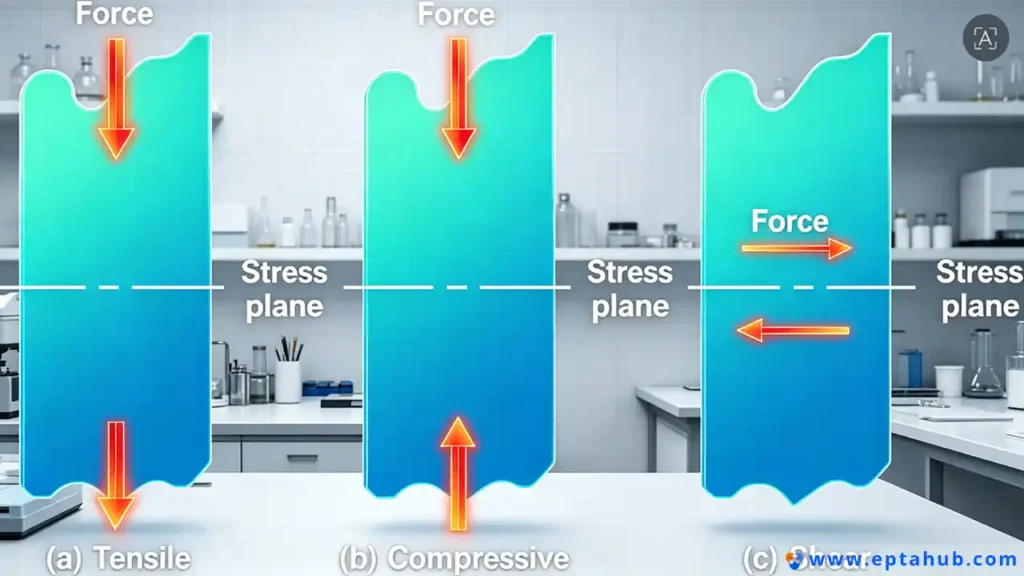
If you bolt a heavy winch to a custom-milled aluminum bracket on a truck, the bracket experiences tensile strain. As the winch pulls the cable, the bracket wants to stretch forward. We use tensile strain calculations to ensure the bracket doesn’t stretch so far that the bolts tear out of the chassis.
The Formula:
Tensile Strain (often represented by the Greek letter Epsilon, ε) = Change in Length (ΔL) / Original Length (L).
2. Compressive Strain (Squashing)
Compressive strain is the exact opposite of tensile strain. It occurs when forces push inward on an object, causing it to crush or shorten.
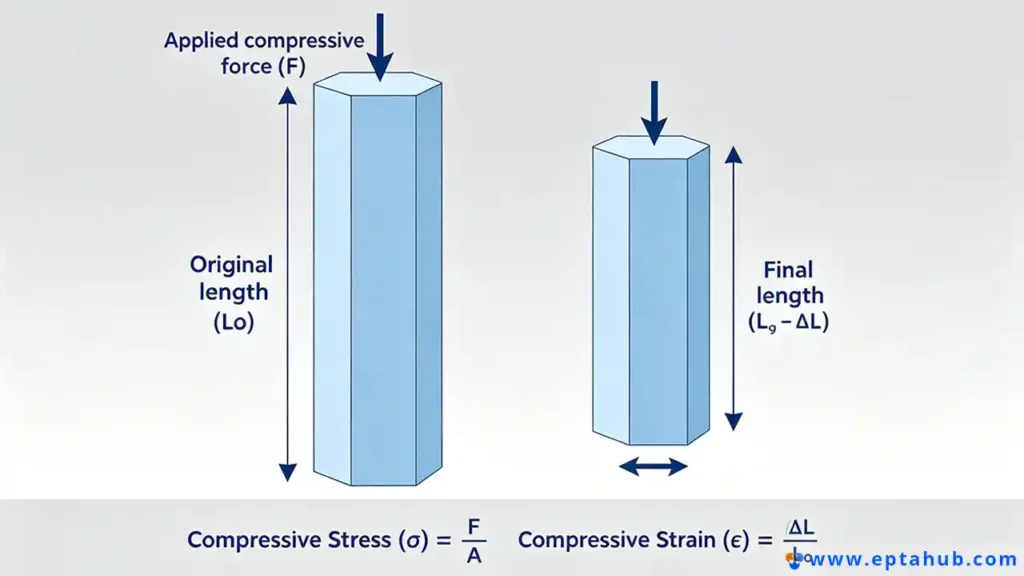
Think of the concrete pillars holding up a bridge, or a customized shock-absorbing pad we might 3D print out of flexible elastomer at EPTAHUB. The weight of the bridge (or the impact of a machine) pushes down, compressing the material.
The Formula:
The formula is identical to tensile strain (Change in Length / Original Length). However, because the object is getting shorter, the change in length is a negative number, meaning compressive strain is always expressed as a negative value.
3. Shear Strain (Sliding)
This one is slightly harder to visualize but incredibly common in mechanical assemblies.
Shear strain occurs when opposing forces push on an object, but they are not aligned. Imagine pushing a thick deck of cards flat on a table. If you put your hand on top and push forward, while the bottom cards stay gripped to the table, the deck slants into a parallelogram.
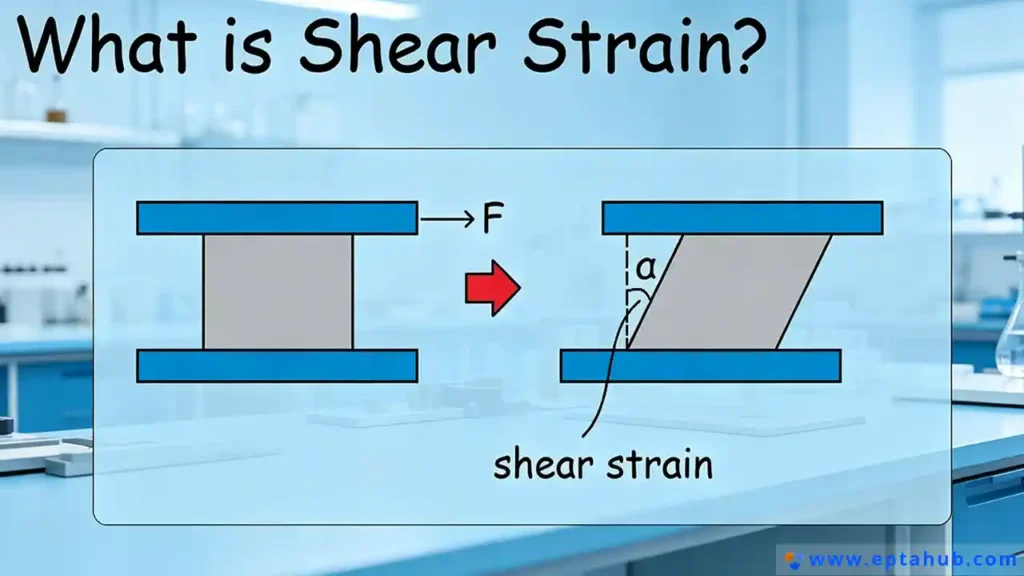
In engineering, we see shear strain in fasteners. If you bolt two heavy plates together and pull them in opposite directions, the plates act like scissors, trying to slice the bolt in half. The distortion of that bolt right before it snaps is shear strain.
The Shear Strain Equation:
Shear strain (represented by the Greek letter Gamma, γ) is calculated differently. It is not about a change in length; it is about a change in angle.
Shear Strain = Tangent of the angle of deformation. (For very small deformations, which is typical in metals, the shear strain is approximately equal to the angle itself, measured in radians).
4. Volumetric Strain (Pressure from All Sides)
Volumetric strain (also called bulk strain) occurs when an object is subjected to equal pressure from all directions, causing it to shrink in total volume without necessarily changing its fundamental shape.
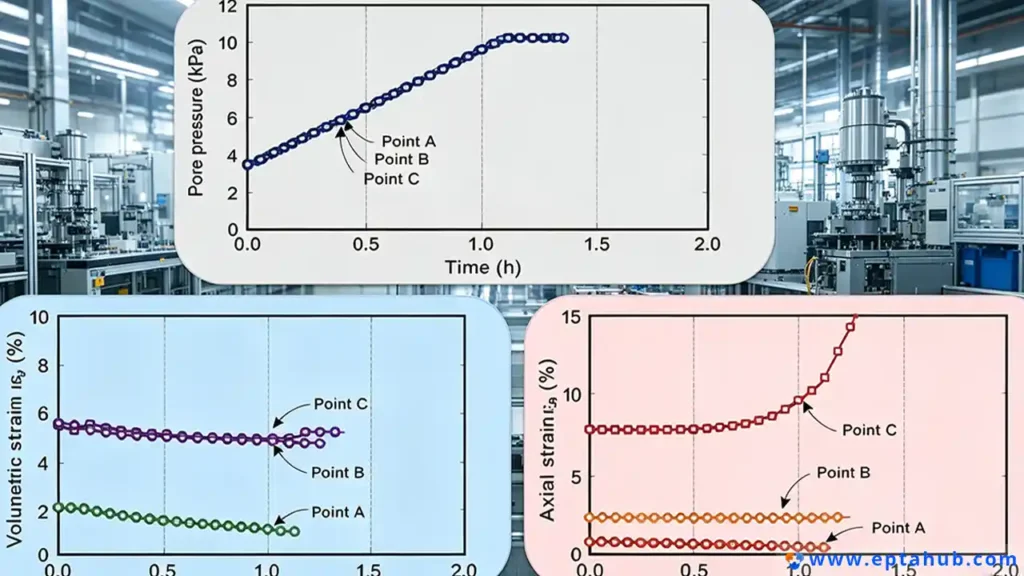
The classic example is taking a block of solid rubber and dropping it to the bottom of the ocean. The immense hydrostatic pressure from the water squeezes the block equally from the top, bottom, and all sides. The block remains a cube, but it becomes a smaller cube.
The Formula:
Volumetric Strain = Change in Volume (ΔV) / Original Volume (V).
The Stress-Strain Curve
You cannot talk about the strain formula without talking about the stress-strain curve.
If you are a procurement manager looking at a material data sheet provided by EPTAHUB, the most important piece of information on that document is the stress-strain curve. It is a graph that visually maps exactly how a specific material behaves as it is stretched to its death.
Every material in the world—from cheap PLA plastic to aerospace-grade Titanium—is tested in a laboratory. A machine grabs a sample of the material and slowly pulls it apart (applying Stress), and simultaneously measures exactly how much it stretches (Strain).
Source Validation: The methodology for generating a stress-strain curve via tensile testing is rigorously defined by global standards, most notably ASTM E8/E8M (Standard Test Methods for Tension Testing of Metallic Materials) and ASTM D638 (Standard Test Method for Tensile Properties of Plastics).
When you look at this graph, you will see it divided into two distinct engineering zones:
Zone 1: Elastic Deformation (The Rubber Band Phase)
When you first start pulling on a piece of steel, it stretches. But if you let go of the tension, the steel will instantly snap back to its exact original length.
This is called elastic deformation. The material is straining, but the internal molecular bonds are not broken. In 99% of engineering applications, we design parts to stay strictly inside this elastic zone. We want the drone arm to flex in the wind, but we want it to snap perfectly back to shape when the wind stops.
Zone 2: Plastic Deformation (The Point of No Return)
If you keep pulling the steel harder and harder, you will eventually hit a point on the graph called the Yield Point.
Once you cross the Yield Point, the rules change. You are now in the plastic deformation zone. You have permanently altered the molecular structure of the material. If you let go of the tension now, the steel will not snap back to its original length. It is permanently stretched and bent out of shape.
If a part reaches plastic strain in the real world, it has functionally failed.
Young’s Modulus
If you want to know what is strain and how is it calculated in a real-world engineering environment, you have to understand the bridge between stress and strain. That bridge is called Young’s Modulus (also known as the Modulus of Elasticity).
Think of Young’s Modulus as a measurement of a material’s stiffness.
If you apply a massive amount of stress to a piece of rubber, it will experience a massive amount of strain (it stretches easily). It has a low Young’s Modulus.
If you apply that exact same amount of stress to a block of tungsten, the strain will be so small you would need a microscope to measure it. It has an incredibly high Young’s Modulus.
When we are evaluating materials at EPTAHUB to determine if they can survive your product’s operational environment, we rely on Hooke’s Law. For materials operating in the elastic zone (before they permanently bend), the relationship is a simple, linear equation:
Stress = Young’s Modulus × Strain
Because Young’s Modulus is a known, laboratory-tested constant for almost every material on earth, engineers use this formula in reverse to predict exactly how much a part will stretch before we ever manufacture it.
A Real-World Calculation: Engineering in Action
Let’s step away from the theory and look at a practical example of how a manufacturing engineer uses the strain formula.
Imagine you are a procurement manager sourcing a custom suspension linkage for a lightweight off-road vehicle. You send the CAD file to EPTAHUB for a quote. You want the part CNC machined out of Aluminum 6061-T6.
Before we machine the part, we need to verify that the aluminum linkage won’t stretch too far and throw the vehicle’s suspension geometry out of alignment.
The Scenario:
- The aluminum linkage is exactly 10 inches long (Original Length, L).
- The vehicle’s suspension will apply 5,000 pounds of pulling force (Stress) to the linkage.
- The cross-sectional area of the linkage is 0.5 square inches.
Step 1: Calculate the Stress
Stress is simply force divided by area.
Stress = 5,000 lbs / 0.5 sq inches = 10,000 PSI (Pounds per Square Inch).
Step 2: Find the Young’s Modulus
We look up the material data sheet for Aluminum 6061-T6. The universally accepted Young’s Modulus for this specific alloy is approximately 10,000,000 PSI.
(Source Validation: MatWeb Material Property Data, Aluminum 6061-T6 standard properties).
Step 3: Calculate the Strain
Using Hooke’s Law (Strain = Stress / Young’s Modulus):
Strain = 10,000 PSI / 10,000,000 PSI
Strain = 0.001
Step 4: Calculate the Physical Deformation
Now we take that dimensionless strain number (0.001) and apply it to the original length of the part to find out exactly how much it will stretch.
Change in Length (ΔL) = Strain × Original Length
Change in Length = 0.001 × 10 inches
Change in Length = 0.01 inches.
The Engineering Conclusion:
When the vehicle hits a bump and applies 5,000 pounds of force, that 10-inch aluminum linkage will stretch exactly 0.01 inches. When the force is removed, it will snap back to exactly 10 inches.
Because 0.01 inches is well within the acceptable tolerance for the suspension design, and because the stress (10,000 PSI) is far below the Yield Point of Aluminum 6061-T6 (which is roughly 40,000 PSI), we can confidently tell the procurement manager that the design is sound. We will then proceed to machine the parts.
If the calculation had shown the part stretching by 0.5 inches, or exceeding the Yield Point, we would have immediately stopped the quoting process and advised the client to either thicken the geometry or upgrade to a stronger material like Titanium or 7075-T6 Aluminum.
Why Strain Matters for Manufacturing Procurement?
Understanding the strain meaning is not just an academic exercise for college students; it is a critical financial tool for OEMs and procurement teams.
When you order custom manufactured parts, you are constantly balancing cost against performance. Over-engineering a part costs money. Under-engineering a part costs your reputation.
- Avoiding Material Overkill: I frequently see clients request parts to be machined from expensive 17-4 Stainless Steel when the actual operational stress would result in negligible strain on a much cheaper, easier-to-machine material like 6061 Aluminum. Understanding strain calculations allows you to confidently downgrade your material choice, saving thousands of USD in raw material and CNC machine time.
- Validating 3D Printed Plastics: With the rise of industrial 3D printing, engineers are replacing metal brackets with carbon-fiber reinforced nylon (PA12-CF). However, polymers have entirely different stress-strain curves than metals. They are highly susceptible to “creep” (continuous, slow strain over a long period under a constant load). If you don’t calculate for creep strain, that plastic bracket will slowly warp over the course of a year until it fails.
- Assembly Tolerances: If you are manufacturing an assembly where multiple parts press-fit together, you must calculate the compressive strain on the mating surfaces. If the strain is too high, the parts will crush each other, leading to micro-cracking and eventual structural failure.
Conclusion: Designing for the Real World
To summarize what is strain and its types: Strain is simply the mathematical measurement of deformation. Whether an object is being pulled (Tensile), crushed (Compressive), twisted (Shear), or squeezed from all sides (Volumetric), the fundamental laws of physics dictate exactly how it will react.
At EPTAHUB, we do not just blindly feed CAD files into our CNC machines or 3D printers. We look at the geometry, we look at the material properties, and we anticipate the strain.
Whether you are designing a one-off prototype for a medical device or scaling up to injection mold 10,000 consumer electronics enclosures, understanding how your parts will deform under stress is the difference between a successful product launch and a costly recall.
Stop guessing how strong your parts are. Run the math, understand the stress-strain curve, and choose a manufacturing partner who understands the physics of failure.