











Hello, this is your senior engineer from Eptahub. In the vast world of polymers, there are high-performance exotics that grab the headlines, but then there are the unassuming, relentless workhorses that build the modern world. High-Density Polyethylene, or HDPE, is the undisputed champion of this latter category.
The full name is High-Density Polyethylene. On the bottom of a container, you know it as the recycling symbol #2.
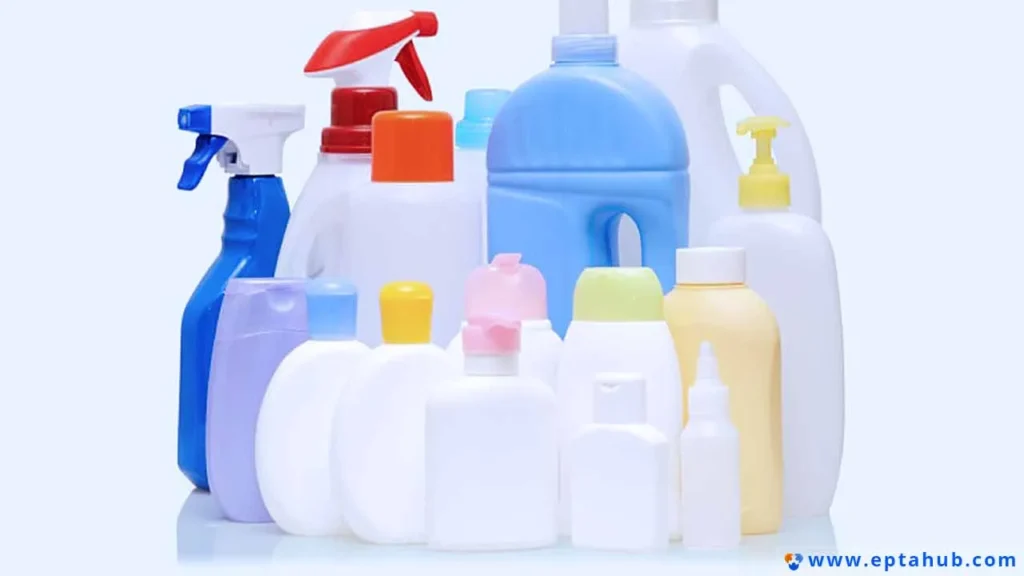
From the milk jug on your breakfast table and the gas pipe under your street to the chemical storage tank at an industrial facility, HDPE is everywhere. Its dominance is not accidental. It stems from a near-perfect balance of three engineering virtues: low cost, exceptional durability, and formidable chemical resistance.
However, for an engineer or a procurement specialist, simply knowing “what HDPE stands for” is insufficient. It’s a gateway to costly errors. “HDPE” is not a single material; it’s a vast family of grades and formulations, each tuned for a specific purpose. Choosing the right one—and specifying it correctly—is the difference between a product that lasts for decades and one that fails in months.
What Makes HDPE “High-Density”?
To truly understand HDPE, we need to look at its structure. The name itself holds the key.
All polyethylene plastics are made by polymerizing ethylene monomers (C₂H₄) into extremely long chains, like linking together countless tiny paperclips. The key difference between HDPE and its more flexible cousin, Low-Density Polyethylene (LDPE), lies in how these chains are structured.
- Low-Density Polyethylene (LDPE – #4 Plastic): Imagine a pile of tree branches. The polymer chains have significant side-branching, preventing them from packing tightly together. This creates a less-ordered, or “amorphous,” structure. The result is a more flexible, less dense material. Think plastic wrap or squeezable bottles.
- High-Density Polyethylene (HDPE – #2 Plastic): Now, imagine a pile of neatly stacked logs. The polymerization process for HDPE creates very long polymer chains with minimal branching. These straight, linear chains can pack together in a highly ordered, crystalline fashion.
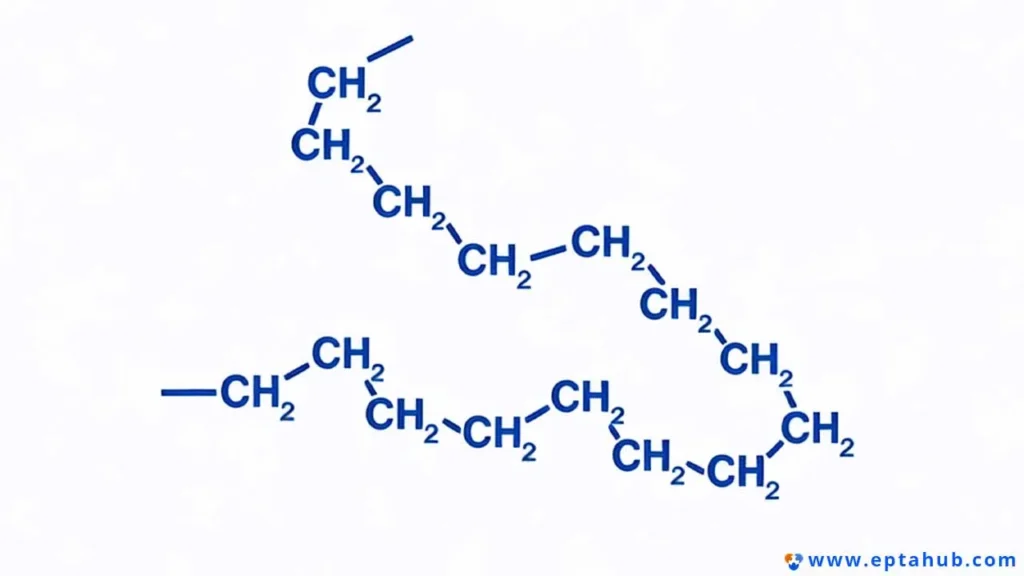
This tightly packed, crystalline structure is the entire secret to HDPE’s success. It is directly responsible for its signature properties:
- “High-Density”: Because the molecules are packed so closely, the material has more mass per unit volume. This is its namesake property.
- Stiffness and Strength: The ordered, crystalline regions act like reinforcing fibers within the material, giving HDPE its characteristic stiffness and high strength-to-density ratio.
- Opacity: The crystalline structures scatter light, making HDPE naturally translucent or opaque (often a milky white), unlike the clearer LDPE.
- Chemical Resistance: The tightly packed molecules present a more difficult barrier for chemical solvents to penetrate, contributing to HDPE’s excellent chemical resistance.
Understanding this fundamental distinction—linear chains vs. branched chains—is the first step to becoming an expert in specifying these materials.
The Engineer’s Datasheet: Core Properties of HDPE
When you receive a technical data sheet (TDS) for a specific grade of HDPE, these are the critical properties you will be evaluating. Let’s translate them into practical terms.
Mechanical Properties
This is how the material behaves under physical stress.
- Tensile Strength: This measures the force required to pull the material apart. HDPE has a good tensile strength, typically ranging from 20 to 40 MPa (3,000 to 5,800 psi). This is what makes HDPE pipes strong enough to handle internal pressure.
- Flexural Modulus (Stiffness): This measures the material’s resistance to bending. HDPE is considered a semi-rigid plastic. It’s not as stiff as a material like ABS or PVC, but it’s far more rigid than LDPE. This allows it to hold its shape in applications like buckets and crates.
- Impact Strength (Toughness): This is one of HDPE’s standout features. It can absorb a tremendous amount of energy before fracturing, especially at low temperatures where other plastics become brittle. This is why it’s used for playground equipment and industrial drums that need to withstand rough handling.
- Hardness: Measured on the Shore D scale, HDPE is moderately hard, making it resistant to scratches and abrasion compared to softer plastics. This is why it’s a preferred material for cutting boards.
Chemical Properties
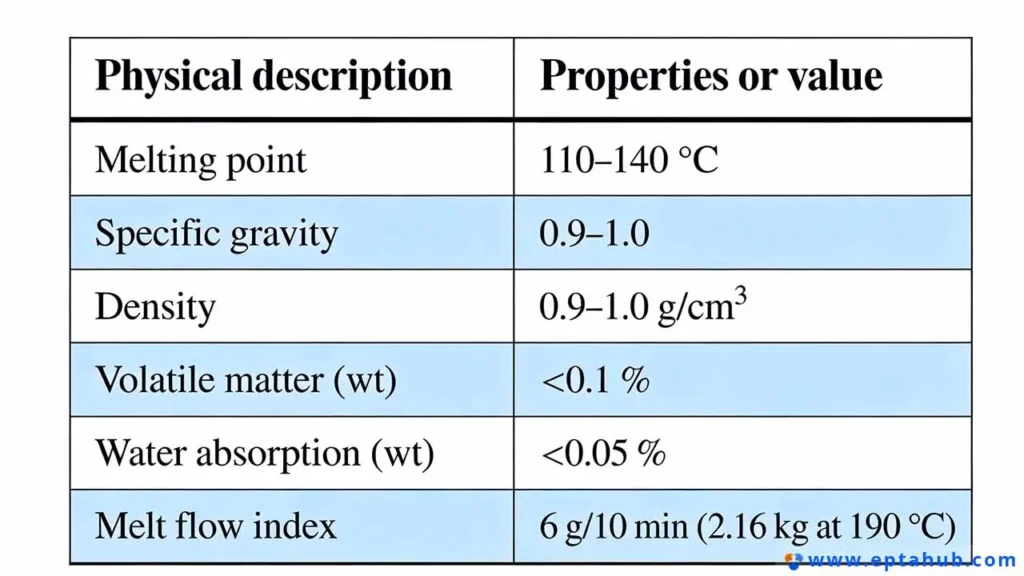
This is arguably HDPE’s superpower.
- Exceptional Resistance: HDPE is famously resistant to a huge range of chemicals, including most strong acids (like hydrochloric acid), strong bases (like sodium hydroxide), alcohols, and detergents. This is why it is the default choice for packaging cleaning products, industrial chemicals, and motor oil.
- Limitations: It is not resistant to strong oxidizing agents (like nitric acid) or certain aromatic and halogenated hydrocarbons which can cause it to swell or soften over time. This is a critical check for material compatibility.
Thermal Properties
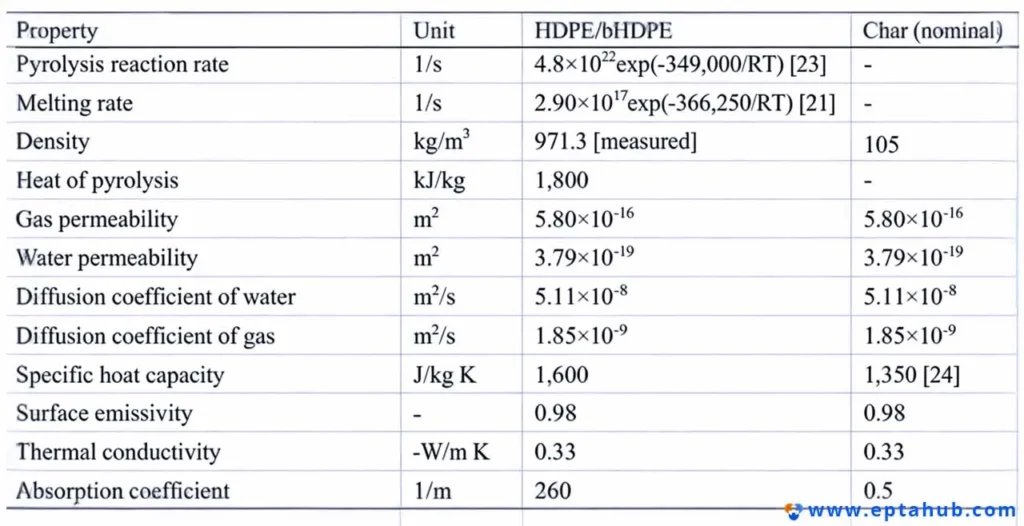
- Service Temperature: HDPE can typically handle continuous service temperatures up to about 80°C (176°F) and short-term exposure up to 100-120°C (212-248°F). It is not suitable for hot water or steam applications.
- Low-Temperature Performance: Its toughness extends well below freezing, making it suitable for outdoor applications in cold climates where materials like PVC would shatter.
- Melting Point: HDPE has a melting point of around 130-137°C (266-279°F), which is important for processing.
Table 1: Typical Properties of High-Density Polyethylene (HDPE)
| Property | Typical Value (Metric) | Typical Value (Imperial) | Engineering Significance |
|---|---|---|---|
| Density | 0.94 – 0.97 g/cm³ | 0.034 – 0.035 lb/in³ | Basis of its name; high strength-to-weight ratio. |
| Tensile Strength at Yield | 20 – 40 MPa | 3,000 – 5,800 psi | Resistance to being pulled apart; key for pressure pipes. |
| Flexural Modulus | 800 – 1500 MPa | 116,000 – 217,000 psi | Stiffness; resistance to bending and flexing. |
| Notched Izod Impact | 20 – 200 J/m | 0.4 – 3.7 ft-lb/in | Toughness; ability to withstand sudden blows without breaking. |
| Hardness (Shore D) | 60 – 70 | 60 – 70 | Resistance to surface indentation and abrasion. |
| Max. Continuous Service Temp | ~80 °C | ~176 °F | Defines its upper limit for use; not for hot applications. |
| Melting Point | 130 – 137 °C | 266 – 279 °F | The temperature at which it processes (e.g., melts for molding). |
From Pellet to Product: Key Manufacturing Processes
Raw HDPE resin is supplied as small, milky-white pellets. These pellets are then melted and formed using several high-volume manufacturing methods. Understanding these processes helps you understand the types of products you can source.
- Blow Molding: This is the quintessential HDPE process. It’s how nearly all hollow containers are made.
- Process: An extruder creates a hollow tube of molten plastic called a “parison.” A two-part mold closes around the parison, and compressed air is blown inside, inflating the plastic against the cold mold walls.
- Products: Milk jugs, detergent bottles, shampoo bottles, industrial drums, fuel tanks.
- Injection Molding: Used to create complex, solid 3D shapes.
- Process: The HDPE pellets are melted and then injected under high pressure into a precisely machined steel mold. The plastic cools and solidifies into the shape of the mold cavity.
- Products: Bottle caps, storage crates, buckets, housewares, toys, trash cans, automotive components.
- Extrusion: Used to create continuous linear profiles.
- Process: Melted plastic is pushed continuously through a shaped die to form a constant cross-section. This can be for pipes, sheets, or films.
- Products: Water and gas pipes (the largest single use of HDPE), corrugated drain pipes, plastic lumber, geomembranes for landfill liners, and thick sheet stock for fabrication.
The Application Landscape: Where HDPE Excels
HDPE’s unique combination of properties makes it the go-to material in countless industries.
1. Piping and Infrastructure
This is the single largest market for HDPE, and for good reason.
- Applications: Potable water distribution, natural gas pipelines, agricultural irrigation, corrugated drainage pipes, sewer and wastewater lines, and conduits for fiber optic and electrical cables.
- Why HDPE?
- Corrosion/Chemical Resistance: Unlike metal pipes, HDPE will not rust or corrode from contact with soil, water, or a vast range of chemicals.
- Flexibility: It can be supplied in long, coiled lengths, reducing the number of joints needed. It can also be bent to accommodate gentle curves, simplifying installation.
- Leak-Proof Joints: Sections of HDPE pipe are joined by heat fusion (butt fusion or electrofusion), where the ends are melted and pressed together. This creates a monolithic, permanent, leak-free joint that is as strong as the pipe itself.
- Durability: It is tough enough to withstand the rigors of installation and resist cracks from ground shifting or seismic activity.
2. Packaging (Rigid Containers)
This is its most visible application.
- Applications: Milk jugs, juice and water bottles, household chemical containers (bleach, detergent), motor oil bottles, industrial chemical drums, buckets, and food storage containers.
- Why HDPE?
- Chemical Inertness: It does not leach chemicals into the contents and is not attacked by the contents. This makes it safe for food (look for FDA-compliant grades) and reliable for aggressive chemicals.
- Impact Strength: Containers can be dropped without shattering.
- Lightweight: Reduces shipping costs compared to glass or metal.
- Processability: It is perfectly suited for high-speed blow molding.
3. Sheet and Board Stock (Fabrication)
Thick sheets of HDPE are a versatile material for fabrication and machining.
- Applications: Chemical storage tanks, cutting boards (food service), playground equipment (e.g., slides), boat components (“StarBoard” is a popular brand), and liners for chutes and hoppers to promote material flow (due to its low friction).
- Why HDPE?
- Weldability: Sheets can be welded together using hot air plastic welding techniques to create large, complex, leak-proof structures like tanks.
- Machinability: It can be easily cut, routed, and drilled using standard woodworking tools.
- Weather Resistance (with UV stabilizers): Virgin HDPE is susceptible to degradation from sunlight. However, grades formulated with UV inhibitors (often by adding carbon black) can last for many years outdoors.
The Disadvantages:HDPE’s Weaknesses
No material is perfect. Understanding HDPE’s limitations is just as important as knowing its strengths.
- Low Temperature Resistance: As noted in Part 1, HDPE has a relatively low maximum service temperature (~80°C). It cannot be used for hot liquids, steam, or applications where it will be exposed to significant heat. It will soften, deform, and lose its strength.
- Susceptibility to UV Degradation: Natural, unpigmented HDPE is not suitable for long-term outdoor use. UV radiation from sunlight will break down the polymer chains, causing the material to become brittle and crack. For any outdoor application, you must specify a UV-stabilized grade. Carbon black is the most common and effective additive for this.
- High Thermal Expansion: HDPE has a high coefficient of thermal expansion, much higher than metals. This means it expands and contracts significantly with temperature changes. This must be accounted for in designs, especially for long pipe runs or large flat panels, by incorporating expansion loops or appropriate fastening systems to prevent buckling.
- Difficult to Bond: Due to its non-polar, chemically inert surface, HDPE is notoriously difficult to glue or bond with conventional adhesives. Mechanical fastening or thermal welding are the only reliable joining methods.
- Subject to Stress Cracking (ESCR): While resistant to most chemicals, HDPE can be susceptible to a failure mode called Environmental Stress Cracking (ESC). This occurs when the material is under tensile stress (e.g., from a tight fastener or internal pressure) and simultaneously exposed to certain agents like soaps, detergents, or alcohols. The combination can cause slow-growing cracks to form and lead to premature failure. Different grades of HDPE have vastly different ESCR ratings.
Case Study: The Failing Fuel Canisters
- The Scenario: A company designed a new line of portable, 5-gallon fuel canisters. They knew HDPE was the standard material for this application due to its chemical resistance to gasoline. They put out an RFQ for “5-gallon HDPE containers” and selected a supplier who offered a low price using a general-purpose “blow molding grade” HDPE.
- The Mistake: The designers and procurement team were not aware that there are specialized HDPE grades specifically for fuel tanks. These grades must meet strict regulatory standards for hydrocarbon barrier properties and ESCR. General-purpose HDPE, while resistant to gasoline, is not impermeable to its vapors.
- The Result: The canisters passed initial leak tests. However, within a few months of being on the market, reports came in of the canisters swelling up (“ballooning”) in the sun and emitting a strong smell of gasoline. The volatile organic compounds (VOCs) from the fuel were slowly permeating through the walls of the canister. This not only created a fire hazard but also violated environmental regulations (EPA) regarding evaporative emissions.
- The Root Cause Analysis: The supplier had used a standard HDPE grade that lacked the necessary barrier resins or multi-layer structure required for fuel containment. The “low-cost” option was completely unfit for the purpose. The company had to issue a massive product recall, faced regulatory fines, and suffered immense brand damage. The correct choice would have been a specialized, multi-layer HDPE or a fluorinated HDPE grade designed specifically to block hydrocarbon permeation.
- The Lesson: “HDPE” is not enough. The grade of the material and its specific formulation are as critical as the material itself. For demanding applications, you must match the grade to the challenge.
How to Specify HDPE with Precision?
To avoid the failures described above, your RFQ must be a precise technical communication.
- Specify the Grade and/or Application: Don’t just say “HDPE.” Be as specific as possible.
- Good: “HDPE Sheet, Pipe Grade”
- Better: “HDPE, Black, UV-Stabilized, Pipe Grade PE100 / PE4710”
- Good: “HDPE for Blow Molding”
- Better: “FDA-Compliant, Blow Molding Grade HDPE for food-safe bottles”
- Define the Manufacturing Process: Let the supplier know how the part will be made (e.g., Injection Molding, Extrusion, Blow Molding, Machined from Sheet). This helps them select a resin with the correct Melt Flow Index (MFI), a key processing parameter.
- State the Color and Additives:
- Color: “Natural (milky white),” “Black,” or a custom color match.
- Additives: This is crucial. Explicitly state requirements like “UV Stabilized for outdoor use” or “FDA compliant for direct food contact.”
- Provide a Full Material Specification (If Known): For critical applications, call out a specific material grade from a major manufacturer (e.g., “LyondellBasell Alathon M5370” or equivalent). At a minimum, provide a datasheet with the required properties (e.g., “Tensile Strength > 30 MPa, ESCR > 1000 hours”).
- Reference Industry Standards: For pipes or regulated items, call out the relevant standard.
- Pipe: ASTM D3350, ISO 4427
- Food Contact: FDA 21 CFR 177.1520
FAQs
Q: Is HDPE plastic toxic tohumans?
A: HDPE is considered one of the safest plastics. Natural, virgin HDPE is very stable and does not leach harmful chemicals. Grades intended for food packaging or medical use undergo rigorous testing to be certified by bodies like the FDA. The primary risk would be from additives or colorants, which is why specifying a food-grade material is essential for those applications.
Q: Is HDPE recyclable?
A: Yes, very much so. As #2 in the recycling stream, HDPE is one of the most easily and commonly recycled plastics. It is collected from curbside programs and recycled into non-food applications like plastic lumber, piping, and bottles for non-food items like detergent.
Q: What is the difference between PE100, PE80, and PE4710?
A: These are classification grades for HDPE pipe. The numbers relate to the long-term hydrostatic strength (hoop stress) of the material. PE100 (or PE4710 in the US system) is a higher-performance grade that can withstand a higher pressure for a 50-year design life than PE80. For any pressure pipe application, you must specify the required grade.
Conclusion: From Commodity to Engineered Solution
HDPE may seem like a simple commodity plastic, but that view is a trap. It is a highly engineered material, with a spectrum of grades designed to solve specific challenges. Its successful application hinges on moving beyond the acronym and embracing the details.
By understanding its molecular origins, respecting its physical limits, and—most importantly—specifying it with technical precision, you transform HDPE from a generic choice into a targeted, cost-effective, and highly reliable engineering solution. At Eptahub, this is the level of rigor we apply to every material we source, ensuring that the components we deliver are not just made from the right material, but from the right grade of that material.