










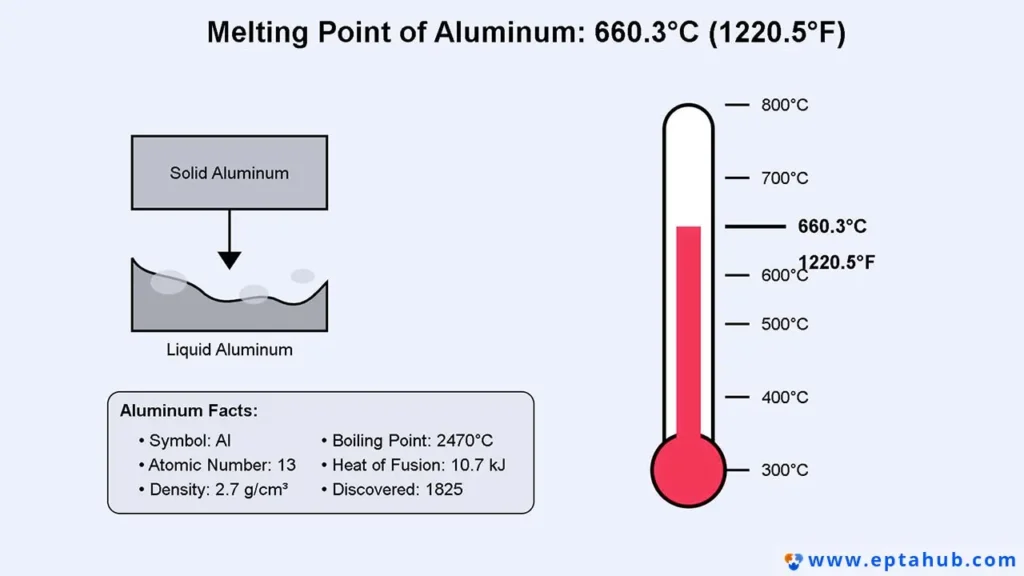
Hello, this is your senior engineer from Eptahub. Let’s address a question that seems deceptively simple: “What is the melting point of aluminum?” The number you’ll find in any physics textbook or a quick online search is precise and unambiguous: 660.3°C (1220.5°F).
For a physicist, that is the end of the conversation. For an engineer, a designer, or a procurement specialist, that number is not the answer; it is the beginning of a much more critical and nuanced discussion. In my career, I have seen more manufacturing problems, failed components, and flawed designs stem from a superficial understanding of this single property than almost any other. Relying on that 660.3°C figure for any practical engineering task is like trying to navigate a complex harbor using only the North Star—it’s a valid reference point, but it ignores all the submerged rocks, shifting tides, and channel markers that will actually determine the success of your journey.

The reality is that in the world of manufactured goods, we almost never work with pure aluminum. We work with a sophisticated family of aluminum alloys, and their behavior during melting is profoundly different and infinitely more complex. This two-part guide is designed to take you beyond the textbook number and into the practical, operational knowledge required on the factory floor and in the design office.
The Physics of Melting: More Than Just a Temperature
Before we can appreciate the complexity of alloys, we must first respect the fundamental process of melting. A solid metal like aluminum is a highly ordered structure—a crystalline lattice where atoms are held in fixed positions by strong metallic bonds, vibrating with thermal energy.
Melting is the process of supplying enough thermal energy to overcome these bonds. As you heat a solid, its atoms vibrate more and more violently. At the melting point, the vibrations become so intense that the atoms break free from the rigid lattice structure. The ordered solid collapses into a disordered liquid, where atoms are free to move and flow past one another.
A critical concept here is the latent heat of fusion. It takes a significant amount of energy just to get the aluminum to its melting point. But once it reaches 660.3°C, it doesn’t instantly become liquid. It requires a massive additional input of energy—the latent heat—to complete the phase transition. During this phase change, you can keep pumping heat into the material, but its temperature will remain locked at 660.3°C until every last crystal has melted. This energy is being consumed to break the atomic bonds, not to raise the temperature. For aluminum, this value is substantial (around 397 kJ/kg), which has major implications for the energy required in foundries and recycling plants.
Pure elements, like pure aluminum, exhibit this sharp, singular melting point precisely because their crystalline lattice is uniform. Every bond is an aluminum-aluminum bond, requiring the same amount of energy to break. This uniformity leads to a clean, predictable transition. But this clean transition is the first thing we sacrifice when we create an alloy.
The Baseline: The World of Pure Aluminum
The official 660.3°C melting point belongs to high-purity aluminum (99.5%+). While we don’t often use it for structural components due to its extreme softness and low strength (a UTS of around 90 MPa, less than a third of 6061-T6), pure aluminum is essential in specific applications where its other properties shine:
- Electrical Conductivity: Pure aluminum (1xxx series alloys, like 1350) is an excellent electrical conductor. It’s used extensively in high-voltage power lines where its light weight is a major advantage over heavier copper.
- Reflectivity: With a highly polished surface, pure aluminum is one of the best reflectors of both visible light and radiant heat. This makes it ideal for decorative trim, lighting fixtures, and thermal shielding.
- Corrosion Resistance: The pure metal forms a highly stable and protective oxide layer, making it suitable for certain types of chemical storage tanks and, most famously, household aluminum foil.
- Workability: Its softness makes it incredibly easy to roll into the ultra-thin sheets used for foil or to form into complex shapes.
In these applications, the single, sharp melting point is a known quantity. But to make aluminum strong enough for a bicycle frame, an aircraft wing, or an engine block, we must introduce other elements. We must create alloys.
How Alloying Creates the “Melting Range”
When you add another element—like silicon, copper, or magnesium—to molten aluminum, its atoms dissolve and distribute themselves throughout the aluminum’s crystal structure upon solidification. This intentional disruption is what gives alloys their enhanced properties, but it also fundamentally changes how they melt.
Instead of a single melting point, alloys have a melting range, defined by two critical temperatures:
- Solidus Temperature (T_s): This is the temperature at which melting begins. Below the solidus, the alloy is 100% solid. At the solidus, the first tiny pockets of liquid begin to form, typically at the boundaries between the different crystal grains.
- Liquidus Temperature (T_l): This is the temperature at which melting is complete. Above the liquidus, the alloy is 100% liquid.
- The “Mushy Zone” (or Freezing Range): This is the critical temperature window between the solidus and the liquidus. In this state, the alloy is a semi-solid slurry—a mixture of solid crystals floating in a liquid melt. The size and characteristics of this mushy zone are arguably the most important melting-related properties for manufacturing.
To understand why this happens, one must visualize a simplified phase diagram. This diagram maps the state (solid, liquid, or mixed) of an alloy based on its temperature and composition. For most aluminum alloys, the solidus and liquidus lines are not a single horizontal line (as they would be for a pure element). Instead, they are two separate, often curving lines that meet only at the pure ends or at a special point called the eutectic.
The eutectic point is the specific alloy composition with the lowest possible melting temperature. For the aluminum-silicon system, this occurs at about 12.6% silicon, where the alloy melts and freezes at a single temperature of 577°C, behaving much like a pure substance. This unique property is why silicon is the undisputed king of alloying elements for casting and brazing.
Key Alloying Elements and Their Impact on Melting
Let’s examine how the most common alloying elements define the melting behavior and, by extension, the manufacturing personality of aluminum alloys.
1. Silicon (Si): The Foundry’s Best Friend
Silicon is the primary alloying element in the 4xxx series (brazing fillers) and most casting alloys (3xx.x series, e.g., A380).

- Melting Point Depression: As mentioned, Si dramatically lowers the melting point of the alloy, reaching the eutectic minimum at 577°C. This means less energy is needed to melt casting alloys, a huge economic advantage.
- Fluidity: Al-Si alloys are renowned for their excellent fluidity in the molten state. They can fill intricate, thin-walled die cavities with ease.
- Narrow Mushy Zone: Alloys near the eutectic composition have a very narrow freezing range. This is highly desirable as it reduces the window for defects like shrinkage porosity and hot tearing to form as the casting solidifies.
2. Copper (Cu): The Double-Edged Sword of Strength
Copper is the key to the high-strength 2xxx series alloys, like 2024, used in aerospace.

- Wide Mushy Zone: Copper creates a very large temperature gap between the solidus and liquidus. For example, 2024 alloy begins melting around 502°C but isn’t fully liquid until 638°C.
- Hot Shortness: This wide mushy zone makes copper-bearing alloys notoriously difficult to weld. As the weld puddle cools and solidifies, it spends a long time in this semi-solid state. The solidifying crystals form a rigid network, but there is still liquid between them. As thermal stresses pull the part, this weak, slushy structure can easily crack open. This phenomenon is called “hot shortness” or solidification cracking.
- High-Strength Casting: Despite the challenges, alloys like 224 were developed for high-temperature casting applications like engine pistons, where the strength imparted by copper is essential.
3. Magnesium (Mg): The Versatile Workhorse
Magnesium is a primary element in the 5xxx series (for strain-hardenable sheet and plate) and the 6xxx series (the heat-treatable extrusions like 6061).

- Moderate Melting Range: The Al-Mg system also has a melting range, but it is generally more manageable than that of the Al-Cu alloys. For 6061 (which also contains silicon), the solidus is 582°C and the liquidus is 652°C.
- Heat Treatment Sensitivity: The presence of magnesium and silicon in 6061 allows for heat treatment (the T6 temper). However, the “solutionizing” step requires heating the alloy to around 530°C, which is getting uncomfortably close to the 582°C solidus. A poorly calibrated furnace can easily cause incipient melting at the grain boundaries, permanently destroying the part’s strength.
4. Zinc (Zn): The Champion of Strength with a Catch
Zinc is the primary alloying element in the 7xxx series, creating the highest-strength aluminum alloys like 7075.
- Low Solidus Temperatures: The combination of zinc, magnesium, and copper in alloys like 7075 results in some of the lowest solidus temperatures among wrought alloys, starting to melt around 477°C.
- Welding and Brazing Difficulty: This extremely low solidus makes fusion welding of 7075 nearly impossible for structural applications. The heat from the welding arc invariably causes liquation and cracking in the heat-affected zone. Brazing is completely out of the question, as any viable filler metal would melt at a temperature high enough to destroy the base material.
Melting Ranges in Practice: A Comparative Table
This table translates the abstract concepts into the hard numbers that engineers and procurement specialists need to reference.
Table 1: Melting Ranges of Common Aluminum Alloys
| Alloy Designation | Primary Alloying Elements | Solidus Temp. (°C) | Liquidus Temp. (°C) | Mushy Zone (°C) | Engineering Implications & Personality |
|---|---|---|---|---|---|
| Pure Aluminum (1100) | N/A (99% Al min) | 646 | 657 | 11 | Behaves almost like a pure element. Soft, not for structure. |
| 6061 | Mg, Si | 582 | 652 | 70 | The all-around star. Weldable, extrudable, but requires careful heat control. |
| 7075 | Zn, Mg, Cu | 477 | 635 | 158 | The strength champion. Very wide mushy zone; essentially non-weldable. Very heat-sensitive. |
| 3003 | Mn | 643 | 654 | 11 | The “can-do” alloy for cookware. Excellent formability, narrow range. |
| A380 (Die Cast) | Si, Cu | 521 | 593 | 72 | The king of die casting. Designed for fluidity and good mechanical properties. |
| 4047 (Brazing) | Si (12%) | 577 | 583 | 6 | A near-eutectic alloy. Designed to melt predictably and flow well as a brazing filler. |
The Great Deceiver: The Aluminum Oxide Layer (Al₂O₃)
Before we can discuss any process that involves molten aluminum, we must first pay respect to its greatest protector and our greatest adversary: aluminum oxide.
Aluminum is a highly reactive metal. The instant a pure, clean aluminum surface is exposed to the oxygen in the air, it reacts to form a microscopic layer of aluminum oxide (Al₂O₃), also known as alumina. This layer is:
- Tenacious: It adheres strongly to the parent metal.
- Self-healing: If you scratch it, it re-forms instantly.
- Chemically Inert: It is highly resistant to further oxidation and many forms of chemical attack, which is why aluminum doesn’t “rust” in the same way iron does.
- Extremely Hard: Alumina is a ceramic material. Rubies and sapphires are crystalline forms of alumina.
- The Critical Property: It has a shockingly high melting point: approximately 2072°C (3762°F).
This creates a bizarre and often confusing situation. You can heat a piece of aluminum in a furnace to 750°C, well above its liquidus temperature, and it may not form a puddle. Instead, it will glow red-hot and may sag, but the aluminum will be contained within a solid, transparent, ceramic “bag” of its own oxide. This invisible skin is strong enough to hold the liquid metal, preventing it from flowing or consolidating.
This single phenomenon has massive, practical implications for every high-temperature process:
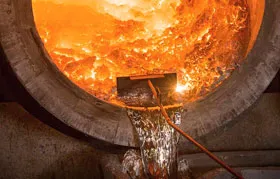
- In Casting: As molten aluminum is held in a crucible, an oxide film constantly forms on the surface. This creates “dross,” a slushy mixture of oxide and trapped metal that must be carefully skimmed off before pouring. Failure to do so results in oxide inclusions being mixed into the casting, creating weak spots that can lead to catastrophic failure.
- In Welding: The oxide layer must be completely removed before a sound weld can be formed. If you try to weld over it, the molten weld puddle will be contaminated, leading to a weak, porous, and brittle joint. This is why the first step in any aluminum welding procedure is aggressive cleaning with a stainless-steel wire brush. Furthermore, it’s why TIG welding aluminum requires Alternating Current (AC). The “electrode positive” portion of the AC cycle acts like a microscopic sandblaster, using the welding arc to blast away the oxide layer ahead of the weld puddle, while the “electrode negative” portion provides the heat for penetration.
- In Brazing and Soldering: Joining aluminum with a lower-temperature filler requires breaking down the oxide layer chemically. This is the sole purpose of flux. The aggressive fluoride and chloride compounds in aluminum brazing flux are designed to chemically dissolve the Al₂O₃ layer, allowing the molten filler alloy to wet the clean aluminum surface beneath.
Melting Properties on the Factory Floor: A Process Deep Dive
Let’s walk through the most common manufacturing processes and see how an alloy’s melting range is the key variable for success.
Casting
This is where aluminum’s relatively low melting range is its greatest asset. It requires far less energy to melt aluminum than to melt steel or cast iron, leading to lower costs, faster cycle times, and longer life for the steel dies used in die casting.
- Die Casting: The process demands alloys with excellent fluidity and a narrow mushy zone. This is why Al-Si alloys like A380 are dominant. Their near-eutectic composition means they stay liquid longer as they flow into the die and then solidify quickly and uniformly, minimizing the risk of shrinkage porosity and allowing the part to be ejected quickly.
- Sand Casting: For larger, more complex parts, alloys with a wider mushy zone can be problematic. As the thick sections of the casting cool slowly, they spend a long time in the semi-solid state. This can lead to dendritic arms of solid metal trapping pockets of liquid, which then create voids or “shrinkage porosity” as they finally cool. This must be managed with careful design of gates and risers (reservoirs of extra molten metal) to feed the casting as it solidifies.
Welding
Welding aluminum is a completely different discipline from welding steel, primarily due to its thermal properties.
- Heat Control is Paramount: Aluminum has very high thermal conductivity (about 3-4 times that of steel). This means heat from the welding arc dissipates into the part very quickly. Consequently, you need a high-amperage, high-heat input to form a weld puddle, but you must also travel quickly to avoid melting a giant hole straight through the material—a phenomenon known as “burn-through.”
- Hot Shortness in Action: This is where our knowledge of alloys like the 2xxx and 7xxx series becomes a hard stop. Trying to fusion weld an alloy with a wide mushy zone like 7075 is asking for trouble. The heat from the weld creates a large heat-affected zone (HAZ) that enters the mushy state. As the part cools and contracts, the thermal stresses will literally tear this weak, slushy zone apart, causing micro-cracks along the edge of the weld that are often invisible but will lead to premature failure. This is why such alloys are typically joined mechanically (rivets, bolts) or with adhesives.
Brazing
Furnace brazing is an elegant way to join complex aluminum assemblies, but it is a game of incredible precision, played in a thermal window that can be terrifyingly narrow.
Case Study: The Melted Heat Exchanger Assembly
- The Scenario: A company was developing a new compact aluminum heat exchanger. The design involved joining several thin-walled 6061 aluminum components. Furnace brazing was selected for its ability to create multiple, clean joints simultaneously.

- The Materials:
- Base Material: Aluminum Alloy 6061. Critical Property: Solidus Temperature of 582°C.
- Filler Material: Aluminum Alloy 4047 (an Al-12%Si eutectic alloy). Critical Property: Liquidus Temperature of 583°C.
- The Flawed Process: A process engineer, more experienced with brazing steel and copper where process windows are wide, set the furnace temperature profile. He knew the 4047 filler needed to be fully liquid to flow into the joints. He set the peak furnace temperature to 605°C, thinking a ~20°C buffer above the filler’s liquidus was a safe margin to ensure complete flow.
- The Critical Miscalculation: His logic failed to account for the most important number in the entire process: the solidus of the base material. The 6061 components would begin to melt at 582°C. The operational window for success was the tiny gap between the filler being fully liquid (583°C) and the parts starting to lose their integrity (582°C). In reality, the ideal brazing temperature is often just 5-10°C above the filler’s liquidus.
- The Result: The first batch of expensive, pre-machined components came out of the furnace as a catastrophic failure. The 4047 filler melted and flowed perfectly, but so did the 6061 base material. The structures sagged, distorted, and the thin walls collapsed into unrecognizable puddles of metal. The financial loss was significant, but the damage to the project schedule was even worse.
- The Inescapable Lesson: The solidus temperature of an alloy is not a guideline; it is a hard physical limit. For processes like brazing, a detailed understanding of the melting ranges of both the base and filler materials is non-negotiable.
Heat Treatment & Extrusion
- Heat Treatment (T6 Temper): To achieve the T6 temper in an alloy like 6061, it must undergo “solution heat treatment.” This involves heating the part to a temperature high enough to dissolve the magnesium and silicon into a solid solution—for 6061, this is around 530°C. This temperature must be held for a specific time and then rapidly quenched. The danger is obvious: 530°C is uncomfortably close to the 582°C solidus. If the furnace has hot spots or the controller overshoots, the part will experience “incipient melting” or “eutectic melting” at the grain boundaries. This creates microscopic pockets of re-solidified metal that severely weaken the material. The damage is irreversible; the part must be scrapped.
- Extrusion: In extrusion, an aluminum billet is heated until it is soft and plastic, then forced through a die. The billet is heated to around 450-500°C. This temperature is a critical balance. It must be hot enough to drastically reduce the force required to push the billet through the die, but it must remain well below the solidus temperature to ensure the billet maintains its solid form and doesn’t begin to slump or melt under pressure.
FAQs
Q: Why is aluminum so much harder to melt in my home foundry than I expected?
A: This is almost certainly due to the aluminum oxide layer. Your heat source is melting the aluminum inside, but the tough, high-temperature Al₂O₃ skin is holding it all together. You need to use a tool to physically break the surface tension of the skin or add a special flux to dissolve it.
Q: What melts faster, aluminum or steel?
A: Aluminum melts at a much, much lower temperature than steel (roughly 660°C vs. 1500°C). It requires significantly less energy and time to bring aluminum to its melting point.
Q: How hot do I need to get to melt aluminum foil?
A: Aluminum foil is nearly pure aluminum, so it will melt at the standard 660.3°C (1220.5°F). However, because of its extreme surface area, it has a very prominent and robust oxide skin. When heated in open air, it often crumbles into a white powder (aluminum oxide) before it can ever coalesce into a liquid puddle.
Q: What is the service temperature limit for aluminum parts?
A: This is a critical design question. Long before it melts, aluminum loses its strength at elevated temperatures. For most common structural alloys like 6061-T6, a significant drop in strength occurs above 150-200°C (300-400°F). For high-temperature applications, steel or specialty “piston alloys” must be used.
Conclusion: A Property That Commands Respect
We began with a simple question and have ended with a comprehensive understanding of a deeply complex and practical subject. The melting point of aluminum is not one number, but a spectrum of behaviors defined by alloy chemistry. It is a property that must be viewed through the lens of the stubborn oxide layer that protects it.
As you move forward to design your next component or issue your next RFQ, carry these three core principles with you:
- Think in Ranges, Not Points: The first question is always, “What is the melting range of this specific alloy?” Forget the 660.3°C number unless you are working with pure aluminum.
- Respect the Solidus: The solidus temperature is the absolute, do-not-exceed ceiling for any high-temperature manufacturing process. It is the temperature at which your part begins to irreversibly lose its structural integrity.
- Acknowledge the Oxide: For any process involving liquid aluminum—from casting to welding to brazing—your plan must include a robust strategy for removing or defeating the aluminum oxide layer.
By internalizing these principles, you are no longer simply quoting a number from a datasheet. You are applying the hard-won knowledge that separates a successful, reliable product from a costly failure. At Eptahub, this level of understanding is the foundation upon which every successful project is built.
References
- AWS D1.2/D1.2M:2014, “Structural Welding Code — Aluminum,” American Welding Society.
- Lucas-Milhaupt, “The Brazing Book,” A comprehensive resource from a leading filler metal manufacturer on the principles of brazing.